


A 12-day pilot project at Sri Venkateswara University (SVU), Tirupati, has demonstrated that a single reactor can process 10 different types of waste and convert them into useful outputs such as biofuels, fertilisers and industrial materials, leaving almost no residue for landfills.
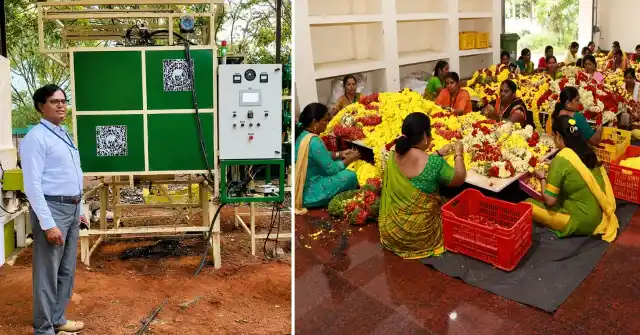
The experiment suggests a possible shift in how cities manage complex waste streams, especially in high-footfall regions like pilgrimage centres.
Massive Waste Load From Pilgrimage City
Tirupati receives more than a lakh pilgrims every day, generating large volumes of floral offerings, coconut shells, plastic bottles and packaged waste. When combined with household garbage, food scraps, poultry waste and even discarded tyres, the city’s waste management challenge becomes increasingly difficult.
Traditionally, municipalities handle this by separating waste into multiple streams and processing them independently. The SVU trial challenges that model by testing whether a single system can manage mixed waste more efficiently.
12-Day Trial With Multi-Waste Reactor
Between 10 and 22 May 2026, engineers from SVU’s College of Engineering, in collaboration with Chennai-based Entity One Company, tested a 50 kg capacity prototype called the Ramcharan Pyrolysis Reactor.
The machine was fed a wide mix of waste including temple flowers, coconut shells, poultry and fish waste, plastics, thermocol and tyres—reflecting the real-world waste profile of Tirupati.
By the end of the trial, all waste streams were converted into usable products such as liquid hydrocarbons, biofuels, fertilisers and carbon-based materials, with minimal leftover residue.
How the Technology Works
The reactor operates using plasma pyrolysis, where waste is placed in a sealed oxygen-free chamber and heated between 300°C and 500°C. Instead of burning, the material breaks down into valuable components.
Because there is no combustion, the process avoids smoke, soot and harmful emissions typically associated with incineration. Unlike conventional systems, this reactor can handle both wet and dry waste in a single unit, reducing the need for multiple processing facilities.
Researchers also noted that the system required minimal pre-sorting, a major advantage in Indian cities where waste segregation remains inconsistent.
Turning Temple Waste Into Resources
A significant portion of Tirupati’s waste comes from temple offerings, especially flowers that are discarded in large quantities every day. Similar initiatives in India have already explored converting floral waste into compost and biodegradable products, but the SVU project integrates it into a larger multi-waste processing system.
Here, floral waste is treated alongside plastics, food waste and industrial scraps in one continuous process, expanding its potential applications.
Addressing India’s Growing Landfill Challenge
With urban landfills reaching capacity in many cities, technologies that recover value from waste are gaining importance. Similar efforts, such as biomining projects in Chennai, have already demonstrated how legacy waste can be converted into usable materials like furniture and construction inputs.
The SVU trial focuses on preventing such accumulation in the first place by processing waste before it reaches dumping grounds.
Officials and Researchers See Promising Results
Tirupati Municipal Corporation revenue officer G Ravi, associated with the project, said the technology could significantly reduce the burden on landfills while creating valuable by-products. He described the approach as treating waste as a resource rather than a problem.
Professor Varadarajan, who led the research at SVU’s College of Engineering, said the objective is to show that environmental management and economic value creation can go hand in hand.
Next Steps Toward Scaling the Technology
The 12-day trial remains an early-stage pilot, but researchers are now working on scaling the reactor for larger volumes and real-world municipal use.
If successfully expanded, cities like Tirupati could potentially manage multiple waste streams through a single integrated system, reducing dependence on separate processing facilities.
The broader vision is to support a waste-free model where even mixed urban garbage—from flower garlands to plastic bottles—can be converted into usable resources instead of being dumped in landfills.
