


India has announced the Chenab–Beas Link Tunnel Project, an ambitious river-linking initiative aimed at transferring surplus water from the Chenab basin to the Beas river system and boosting hydropower generation in Himachal Pradesh.
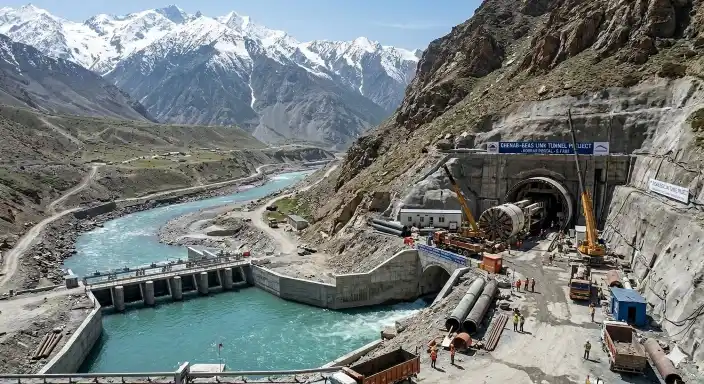
The project proposes the construction of an 8.7-kilometre tunnel and a 113-kilometre canal network to divert water from the Chandra and Bhaga rivers, which form the upper Chenab, into the Beas basin. The estimated cost of the project is ₹2,352 crore.
Designed to address seasonal water shortages in the Beas basin, the project is also expected to support nearly 4,000 MW of additional hydropower capacity, making it both a water management and energy infrastructure initiative.
Phase one includes the construction of a 19-metre-high barrage on the Chandra River near Koksar village in Himachal Pradesh’s Lahaul Valley. Water from the upper Chenab basin in the western Himalayas would then be channelled into the Beas river system through the proposed tunnel.
The project is expected to be implemented by the National Hydroelectric Power Corporation (NHPC), a central public sector enterprise engaged in hydropower development across the country.
Although the Chenab carries an estimated annual flow of around 35 million acre-feet, the proposed diversion would involve less than 1 million acre-feet of water.
The proposal has attracted attention in Pakistan because the Chenab is one of the western rivers governed under the Indus Waters Treaty signed between India and Pakistan in 1960. Under the agreement, the waters of the Indus, Jhelum and Chenab are largely allocated to Pakistan, while India has rights over the eastern rivers Ravi, Beas and Sutlej, along with limited usage rights on the western rivers.
Since the Chenab eventually flows into Pakistan, any infrastructure project involving the river is closely monitored by Islamabad. The Chenab–Beas Link Tunnel also revives a long-standing idea in Indian water planning of transferring water from surplus river basins to regions facing shortages.
Apart from improving water security, the project is expected to contribute to irrigation, flood management and energy generation. While still at the proposal stage, the river-linking project has already emerged as one of the most closely watched infrastructure plans in the Himalayan region amid evolving India-Pakistan water dynamics and broader geopolitical considerations.
