


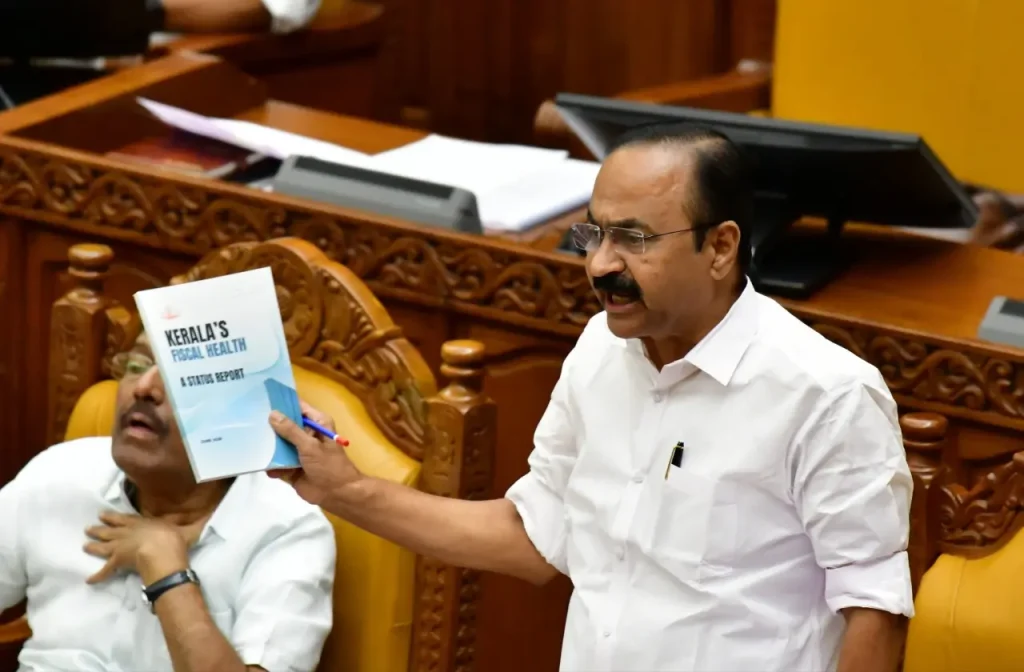
Kerala must create conditions that encourage large-scale private investment, strengthen the role of the cooperative sector in development and employment generation, and facilitate greater participation by central public sector enterprises in infrastructure projects, according to a white paper on the state’s fiscal health presented in the Assembly on Thursday.
The report also recommends that the government take an early decision on the future of the Kerala Infrastructure Investment Fund Board (KIIFB), which was established by the previous Left Democratic Front (LDF) government as a mechanism for off-budget borrowing and infrastructure financing.
White Paper Presented by Chief Minister
The white paper was tabled by Chief Minister V D Satheesan, who also oversees the finance portfolio. The newly elected United Democratic Front (UDF) government had constituted an expert committee shortly after assuming office last month to assess Kerala’s financial position and prepare the report.
The document comes at a time when several states are reassessing their fiscal sustainability. Neighbouring Tamil Nadu has also announced plans to release a similar review of its financial condition.
Ageing Population Adds to Fiscal Pressure
The report highlights demographic changes as a growing challenge for Kerala’s finances. According to a Reserve Bank of India assessment released earlier this year, Kerala and Tamil Nadu are expected to enter the “ageing state” category by 2026, with more than 15 percent of their populations aged over 60 years.
An ageing population increases old-age dependency and places additional pressure on social sector spending, healthcare, pensions and welfare schemes. The white paper argues that addressing these challenges will require difficult policy decisions.
Proposal to Raise Retirement Age
Among its key recommendations, the report suggests increasing the retirement age of Kerala government employees to align with the Central government’s retirement age of 60 years. Currently, state employees retire at 56.
According to the report, every one-year increase in the retirement age could save the state approximately ₹6,000 crore in retirement benefit payments. It also recommends extending the interval between pay commission revisions from five years to ten years, mirroring the Centre’s practice.
Committed Expenditure Consumes Most Revenue
The report paints a concerning picture of Kerala’s fiscal structure. It notes that committed expenditure, including salaries, pensions and interest payments, accounts for around 77 percent of the state’s revenue receipts, significantly higher than the national average of 46 percent.
As a result, less than one-fourth of the state’s revenue remains available for development projects, welfare programmes and infrastructure spending.
Interest payments alone accounted for 20.9 percent of revenue receipts in 2025-26, nearly double the national average of 12.2 percent. Salaries represented 30.1 percent of revenue receipts during the same period, highlighting the growing burden of recurring expenditure.
Rising Debt and Low Capital Spending
Kerala’s outstanding liabilities have reached ₹5.07 lakh crore, according to the report. Despite running a relatively high fiscal deficit, the state has maintained capital expenditure at only 1.3 percent of Gross State Domestic Product (GSDP), one of the lowest levels among Indian states.
The report argues that this indicates borrowed funds are not being sufficiently directed toward productive investments that generate long-term economic growth.
It also raises concerns about parallel financial institutions and mechanisms, including KIIFB and certain public sector undertakings, stating that they place additional pressure on public finances and contribute to future liabilities.
End of Central Support Deepens Challenges
The state’s financial difficulties have been compounded by the end of Goods and Services Tax (GST) compensation and revenue deficit grants from the Centre. At the same time, stricter fiscal deficit norms have reduced Kerala’s borrowing flexibility.
These developments have further constrained the state’s ability to manage expenditure while pursuing development objectives.
Government Inherits Significant Payment Arrears
The white paper reveals that the new administration has inherited substantial pending liabilities. These include ₹21,670 crore in dearness allowance arrears and ₹14,387 crore in dearness relief arrears.
When other deferred payments are added, the state’s total inherited liability stands at approximately ₹48,733 crore, based on data provided by the Finance Department. The report notes that this amount is nearly equivalent to Kerala’s annual net borrowing capacity.
Call for Greater Oversight of KIIFB
The report recommends bringing KIIFB under the direct budgetary oversight of the Finance Department. It also calls for an immediate performance audit by the Comptroller and Auditor General (CAG).
The white paper advises the government to take a timely decision regarding the institution’s future, taking into account the legal implications of bonds already issued and the potential impact on funds raised through budget-backed commitments.
Balancing Welfare and Fiscal Sustainability
The report concludes that Kerala’s fiscal challenges require a combination of investment-led growth, expenditure reforms and structural policy changes. With mounting debt, an ageing population and shrinking fiscal space, the state faces the task of balancing its strong welfare commitments with the need for long-term financial sustainability.
