


Prime Minister Narendra Modi has commissioned the Haldia Bulk Terminal, formally dedicating the facility to the nation. Built to handle 4 million metric tonnes per annum (MMTPA) of dry bulk cargo, the terminal is a fully automated facility located on the Hooghly River and includes direct rail connectivity for cargo evacuation.
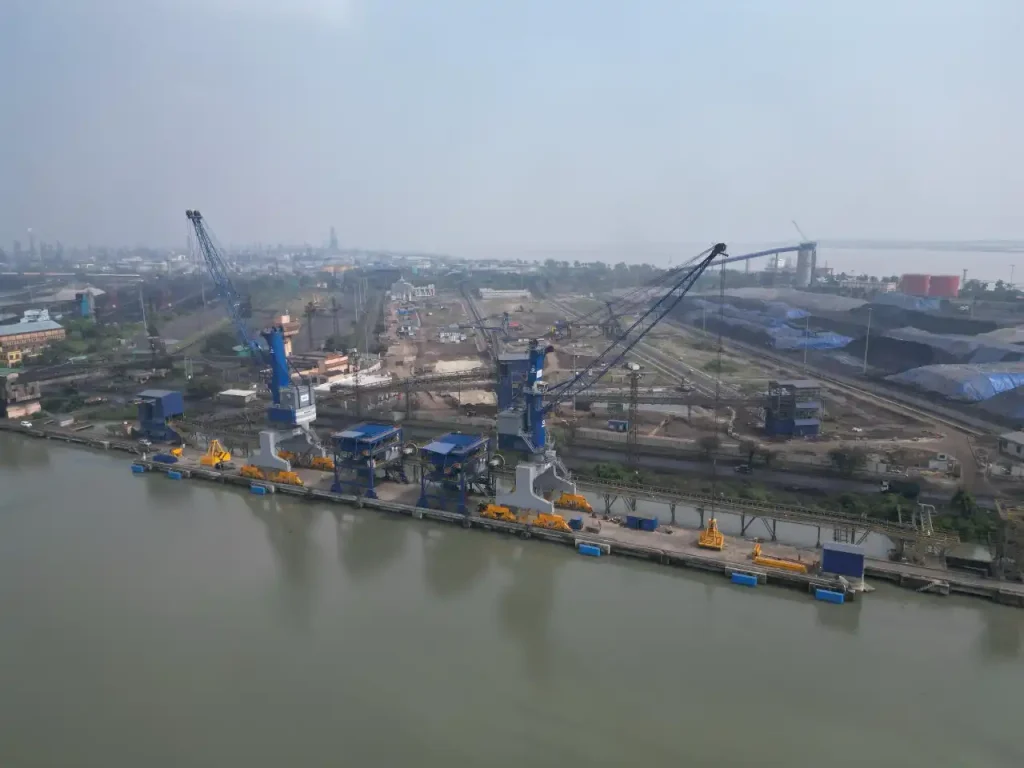
The project marks an important upgrade for bulk cargo movement along India’s eastern maritime corridor, aiming to improve efficiency, reduce handling losses, and streamline logistics for industries dependent on imported raw materials.
Automated Bulk Handling and Rail Connectivity
According to Ashwani Gupta, Whole-time Director and CEO of Adani Ports and Special Economic Zone, the terminal introduces full mechanisation and automated systems designed to minimise cargo losses and eliminate traditional jetty dumping.
The new facility enables cargo to move directly from ships to railway wagons through an integrated rail evacuation system. This approach is expected to enhance operational efficiency, reduce environmental impact, and support cleaner cargo handling along the eastern coast.
Development Under DBFOT Model
The terminal has been developed within the Haldia Dock Complex, which operates under Syama Prasad Mookerjee Port, Kolkata. It was built through a 30-year concession using the Design, Build, Finance, Operate and Transfer (DBFOT) model by HDC Bulk Terminal Ltd.
Construction began on 14 July 2023 and the project was completed within its planned timeline, demonstrating the project execution capabilities of APSEZ.
Strategic Location for Industrial Supply Chains
Situated on the western bank of the Hooghly River, the terminal is designed to handle imported coal and other dry bulk commodities. India’s east coast handles nearly 60% of the country’s dry bulk imports, including coal, bauxite, and limestone.
With improved cargo handling capacity at Haldia, industries in West Bengal, Odisha, and Jharkhand are expected to benefit from lower logistics costs and faster turnaround times for shipments.
Key Infrastructure Features
During the construction phase, several infrastructure components were installed to modernise the facility:
- A 2,000-tonne Railway Wagon Loading System (RWLS)
- A 1.54-kilometre dedicated railway line for direct cargo evacuation
- Upgraded jetty infrastructure
- Automated conveyor systems for cargo movement
- Two stacker-cum-reclaimers for efficient stockyard operations
- Two mobile harbour cranes to accelerate vessel unloading
The integrated rail system allows cargo discharged from ships to be loaded directly onto trains and transported to industrial hubs, reducing port dwell time and improving supply chain efficiency.
Alignment With National Infrastructure Programmes
The Haldia Bulk Terminal supports the government’s broader infrastructure initiatives, including the Sagarmala Programme and the PM Gati Shakti National Master Plan, both of which focus on improving port connectivity and building multimodal logistics networks.
By expanding capacity and introducing automated handling systems, the facility contributes to India’s long-term objective of reducing logistics costs and strengthening maritime infrastructure along the eastern seaboard.
