


Reliance Industries’ proposed nuclear power project in West Bengal, estimated to attract investments of around ₹2 lakh crore, has run into land-related challenges, with the state government searching for an alternative location.
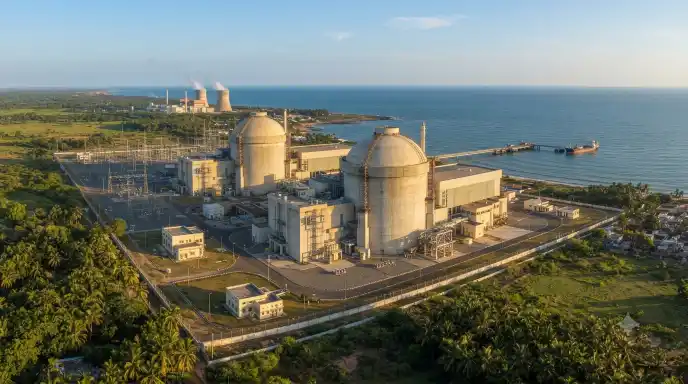
The state leadership has turned down two locations initially considered for the project — Haripur and Nayachar, both in East Midnapore — over concerns about possible resistance from local residents.
The development could delay the proposed investment, which was expected to be implemented over six to seven years.
Haripur and Nayachar Proposals Rejected
Reliance representatives had reportedly suggested Haripur, a coastal village near Contai in East Midnapore, as the location for the nuclear power plant. The site has around 2,000 acres previously identified for a Nuclear Power Corporation of India Limited (NPCIL) project.
NPCIL had earlier planned a nuclear power facility at Haripur with Russian technical collaboration. The proposal received in-principle approval in 2009 but was abandoned in August 2011 following sustained protests by local residents, fishermen and political groups over land acquisition and livelihood concerns.
After Haripur faced resistance within the state leadership, Nayachar, an island near Haldia, was considered as an alternative. However, this location was also reportedly rejected because of concerns about potential disruption near the industrial hub of Haldia.
The government is now exploring other possible locations, although identifying a suitable large land parcel in the state remains a challenge.
₹2 Lakh Crore Investment Proposal
The nuclear power project was discussed during meetings between senior Reliance Group officials, West Bengal Chief Minister Suvendu Adhikari and Chief Secretary Manoj Agarwal in September 2026.
Government sources estimated that the proposed facility could attract investments of approximately ₹2 lakh crore over six to seven years.
The nuclear project was among several investment proposals discussed by Reliance, which also reportedly expressed interest in developing hotels, an AI-enabled data centre and a coal gasification facility in West Bengal.
However, the proposed nuclear plant’s final location, investment commitment, capacity, technology and implementation schedule have not been officially confirmed.
Land Availability Remains a Key Challenge
Finding a suitable location is emerging as a major challenge for the proposed project. Nuclear power facilities generally require large, relatively isolated sites and extensive regulatory and safety assessments.
The earlier Haripur proposal had the advantage of preliminary site studies conducted for NPCIL, including seismic, geotechnical, hydrological, oceanographic and environmental assessments. However, these studies do not automatically constitute approval for a new project.
The West Bengal government has indicated that it plans to facilitate industrial land through direct purchases from landowners and land pooling. A formal land policy is yet to be announced, according to the report.
Private Investment in Nuclear Energy
The proposal comes at a time when India is seeking to expand its nuclear power capacity and attract greater private-sector participation in the energy sector.
For West Bengal, the proposed investment could represent a major industrial and infrastructure opportunity. However, the project will depend on identifying an acceptable location, addressing local concerns and securing the necessary government and nuclear regulatory approvals.
For now, the search for land remains the immediate hurdle facing Reliance’s proposed nuclear power investment in the state.
