


India’s compressed biogas (CBG) sector needs higher plant utilisation, reliable feedstock supplies and better pipeline connectivity to improve profitability and achieve long-term commercial viability, according to a report by EY-Parthenon and the Confederation of Indian Industry (CII).
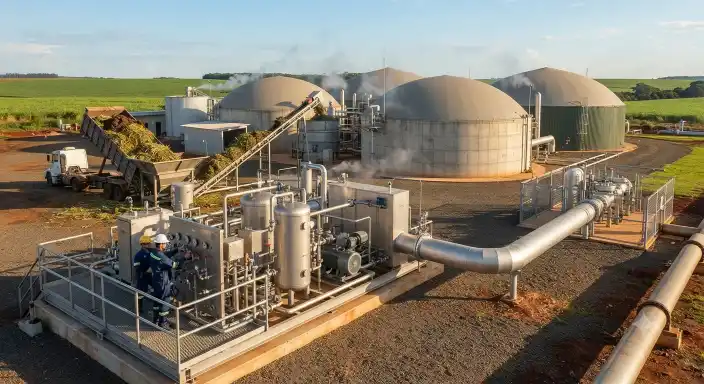
The report, titled India’s Compressed Biogas Opportunity: Pathway to Energy Security, Import Substitution and Decarbonisation, highlights that the sector’s next phase of growth will depend more on operational efficiency and project execution than on additional government price support.
With administered pricing providing revenue visibility, the report identifies better capacity utilisation and lower gas transportation costs as key opportunities to improve project economics.
Pipeline Connectivity to Reduce Transportation Costs
Connecting standalone CBG plants through cluster-based pipeline networks over the next one to three years could reduce gas compression and transportation expenses, the report said. Such networks would also help ensure regular gas evacuation and enable plants to increase production.
The government-approved GOBARdhan scheme supports both cluster-based and standalone pipeline infrastructure to connect CBG plants with trunk pipelines and City Gas Distribution (CGD) networks.
The report assigned pipeline connectivity an impact score of four out of five, indicating its potential to improve the financial performance of CBG projects.
Reliable Feedstock Supply to Improve Plant Utilisation
The report recommended establishing biomass banks and entering into long-term feedstock supply agreements over the next one to two years.
These measures could help CBG producers address seasonal shortages and fluctuations in raw material prices. A consistent supply of agricultural residues and other organic feedstock would allow plants to operate more reliably and improve capacity utilisation.
Additional Revenue Opportunities for CBG Producers
The report also called for immediate relief from state Value Added Tax (VAT) on the CBG component of blended gas to reduce the tax burden and improve the economics of gas supply.
It recommended that fertiliser companies increase procurement of fermented organic manure, a by-product of CBG production. This could create an additional revenue stream for producers and improve overall project economics.
Another proposal is to establish a renewable gas certificate trading framework over the next two to three years or longer. Such a mechanism could allow CBG producers to earn additional income beyond the sale of physical biogas.
India Has 62 Million Tonnes of Annual CBG Potential
The report estimates that India has the potential to produce 62 million metric tonnes of CBG annually. This could theoretically replace the country’s projected LNG imports of 40 million metric tonnes and generate potential annual savings of $20.6 billion.
However, the report’s broader assessment highlights the gap between the country’s estimated production potential and the pace of project execution. Of 838 registered CBG plants as of November 2026, only 210 had been commissioned, while 255 were under construction and 373 had not started construction. Just 24 of the commissioned plants were connected to gas pipelines.
The report emphasises that improving plant utilisation, securing year-round feedstock and reducing the cost of delivering gas to consumers will be central to making India’s CBG sector commercially sustainable and strengthening its contribution to energy security.
