


India’s aviation industry is moving towards greater self-reliance in aircraft maintenance as the country’s leading airlines strengthen their in-house maintenance, repair and overhaul (MRO) capabilities. IndiGo, Air India and Akasa Air are investing in domestic infrastructure to reduce dependence on overseas facilities and address capacity constraints in India’s MRO ecosystem.
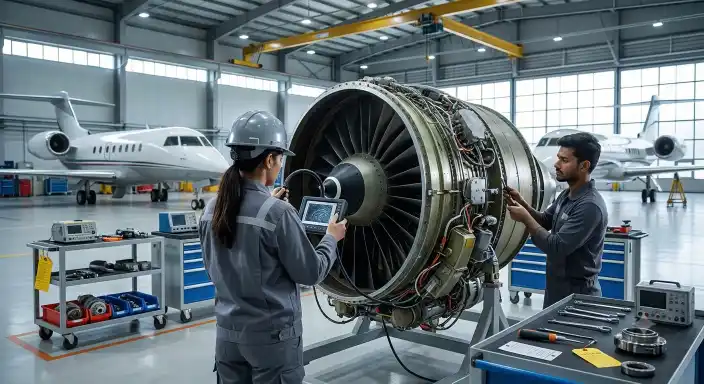
At the Aviation India summit in New Delhi, engineering executives from the three airlines highlighted the need to expand domestic maintenance capabilities as aircraft fleets grow faster than India’s existing MRO infrastructure.
IndiGo Focuses on In-House Maintenance
IndiGo operates 439 aircraft and expects its fleet to reach 444 by mid-November 2026. The airline is increasing its internal maintenance capabilities as domestic MRO capacity remains limited.
According to Parichay Datta, Senior Vice President of Maintenance and Engineering at IndiGo, the airline completed more than half of its approximately 140 annual C-checks in-house last year.
The airline is also exploring long-term partnerships with MRO providers in India and overseas. However, it believes domestic providers need to improve their capacity, technical capabilities and pricing to meet industry requirements.
Air India Builds Bengaluru MRO Hub
Air India is strengthening its maintenance infrastructure to reduce geopolitical and operational risks associated with overseas service providers.
The airline currently outsources around 20% of its line maintenance but plans to bring all of it in-house within six to eight months.
It is developing a major MRO hub in Bengaluru, initially featuring a five-bay hangar capable of accommodating three widebody and two narrowbody aircraft. The facility is expected to expand to 13 bays over the coming years. Additional hangars are also being developed in Delhi.
Air India believes in-house maintenance will provide greater control over costs, turnaround times and operational efficiency.
Akasa Air Plans Noida MRO Facility
Akasa Air has expanded its fleet from 20 aircraft at the time of launch in August 2022 to 45 aircraft. It aims to reach 50 aircraft by March 2027 and has 226 aircraft on order through 2032.
The airline brought line maintenance operations in-house within months of commencing operations. It has also partnered with GMR Aero Technic for heavy maintenance checks.
Akasa plans to establish a small MRO facility at the upcoming Noida International Airport by 2028 to handle basic maintenance requirements. It is also evaluating partnerships with Indian MRO companies, including GMR and Adani.
India’s MRO Industry Faces Growing Demand
The expansion of airline fleets is increasing demand for aircraft maintenance infrastructure, skilled engineers, component servicing and specialised repair facilities.
Growing dependence on overseas MRO providers exposes Indian airlines to geopolitical disruptions, limited maintenance slots, higher costs and operational delays.
The investments by IndiGo, Air India and Akasa Air indicate a broader shift towards developing domestic MRO capabilities. Strengthening India’s maintenance ecosystem will be essential to supporting the country’s aviation growth and reducing reliance on international service providers.
