


Israel has entered a new phase of political negotiations after President Isaac Herzog formally tasked opposition leader Gadi Eisenkot with forming the country’s next government. The former military chief has invited Prime Minister Benjamin Netanyahu’s Likud party and its allies to join a government under his leadership, signalling an attempt to build a broad coalition following the October 27 elections.
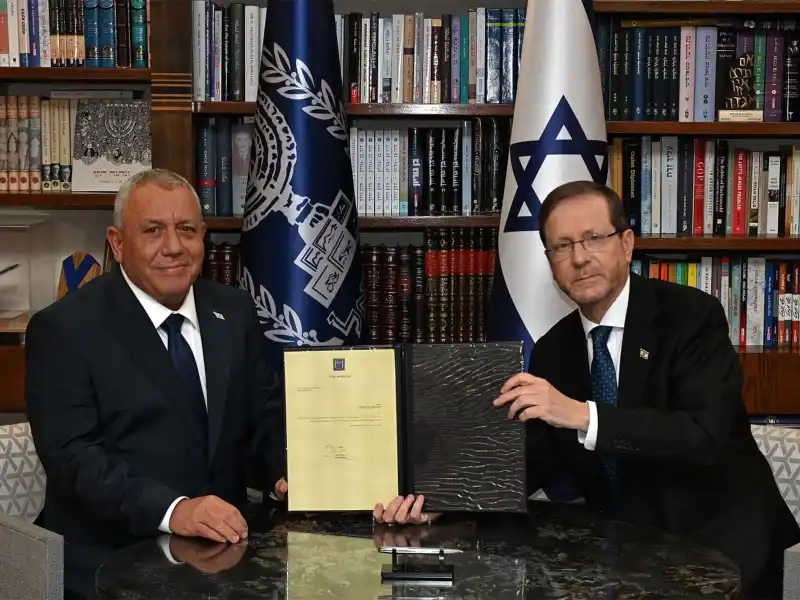
Eisenkot, leader of the Yashar party, received the mandate on November 8 after securing recommendations from 67 members of the 120-member Knesset. Netanyahu received recommendations from 46 lawmakers, while seven did not endorse either leader.
Eisenkot now has 28 days to assemble a coalition, with the possibility of a 14-day extension. A government requires the support of at least 61 lawmakers.
Netanyahu’s Likud Invited to Join
In his first remarks after receiving the mandate, Eisenkot said members of Netanyahu’s Likud party and the Religious Zionist Party were welcome to support a government led by him if they genuinely backed national unity and accepted his proposed principles.
He said unity should represent genuine political partnership rather than serve as a bargaining tool. Eisenkot also called for compromise among political parties, arguing that Israel could not afford another prolonged period of political deadlock.
Netanyahu had earlier proposed a national unity government. However, Eisenkot has maintained that any such arrangement must operate under his leadership. Netanyahu has not indicated that he is willing to step aside.
A Challenging Coalition Arithmetic
The October 27 election did not produce a clear parliamentary majority. Netanyahu’s right-wing and religious bloc secured 53 seats, while Eisenkot’s opposition alliance won 48.
Arab-led parties secured 19 seats, giving Eisenkot a potential route to wider parliamentary support. However, cooperation with these parties remains contentious among some of his prospective coalition partners.
The ultra-Orthodox parties could also play a role in coalition negotiations. Differences over military service exemptions, however, may complicate any agreement.
Eisenkot has ruled out another round of elections and said he intends to form a national emergency government. He has appealed to political factions to support a coalition based on his stated principles.
What Happens Next?
Eisenkot must secure the backing needed to pass a confidence vote in the Knesset within the allotted period. If he fails, President Herzog can grant an extension or invite another lawmaker to attempt government formation. Netanyahu could receive another opportunity if Eisenkot’s effort is unsuccessful.
The negotiations will determine whether Israel gets a new coalition under Eisenkot, a broader arrangement involving Netanyahu’s party, or faces another election.
For now, Eisenkot has received the first opportunity to form the government, but the mandate does not mean he has already secured the premiership. The outcome will depend on the coalition agreements reached in the coming weeks.
