


The National Highways Authority of India (NHAI) has made Multi-Lane Free Flow (MLFF) tolling mandatory for all future National Highway projects, including eligible projects where construction is already underway. The move is aimed at reducing congestion, limiting land acquisition and modernising toll collection across the country’s highway network.

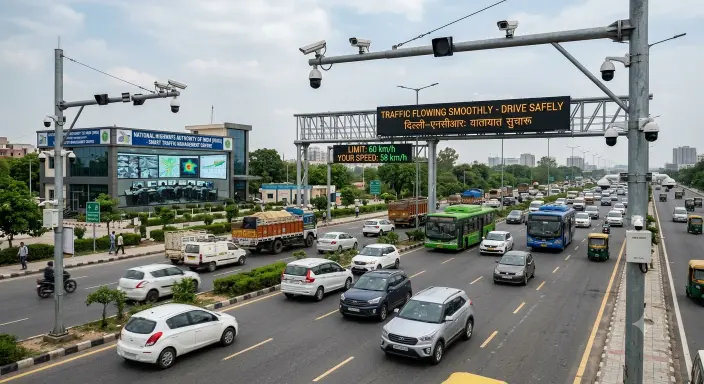
Under the revised design guidelines, toll plazas on future National Highway projects will have a maximum of eight lanes. The system will use overhead gantries equipped with high-performance Radio Frequency Identification (RFID) readers and Automatic Number Plate Recognition (ANPR) cameras to identify vehicles in motion and collect tolls electronically through FASTag.
No More Conventional Toll Booths
The shift to barrier-less tolling is expected to reduce the need for large physical toll plazas and multiple toll booths. Several existing toll plazas on six- and eight-lane highways have more than 20 lanes, with some extending up to 32 lanes to manage vehicle queues.
NHAI estimates that each lane under the revised system can handle around 600 vehicles per hour. By allowing vehicles to pass through without stopping, the technology is expected to improve traffic flow and reduce waiting times.
The authority also expects the new design to eliminate the need for additional land acquisition specifically for expanding toll plaza infrastructure.
How Multi-Lane Free Flow Tolling Works
The MLFF system uses overhead gantries installed across highways. RFID readers detect FASTags, while ANPR cameras capture vehicle registration numbers. The system identifies vehicles as they pass through and deducts the applicable toll electronically without requiring them to stop at a barrier.
Vehicles without valid or functional FASTags may receive electronic notices under the applicable toll collection rules. Backup gantries will also be installed to support vehicle identification and toll collection.
Safety and Infrastructure Requirements
The revised guidelines specify a series of infrastructure and safety requirements for the new tolling system. These include a minimum six-metre clearance for overhead gantries, advance warning signs and variable message displays approximately one kilometre before tolling points.
Adequate high-mast lighting will also be required to support road safety and ensure the effective functioning of cameras, RFID readers and other electronic equipment. Toll plazas should be located on straight stretches of highways wherever feasible.


New Rules for Upcoming and Ongoing Projects
The revised design will apply to National Highway projects at different stages of development. Projects currently at the Detailed Project Report stage must incorporate the new layout in their bidding documents. For projects already awarded or under construction where toll plaza construction has not begun, the revised design will be adopted through changes to the scope of work.
The new guidelines replace earlier toll plaza design provisions for four-lane and wider highways. However, two-lane highways with paved shoulders will continue under the existing tolling system.
The move marks another step in India’s transition towards technology-driven highway infrastructure, with the government seeking to make toll collection faster and reduce the physical footprint of toll plazas.
