


Kerala-based banking expert Krishnakumar K.T. has proposed a new approach to AI-driven banking that focuses on financial empowerment rather than loan recovery. The Chairman and Managing Director of Olivia Grameen Credits presented his ideas at the US–India Super Intelligence Leadership Dialogue held at the US Consulate General in Mumbai on October 7.
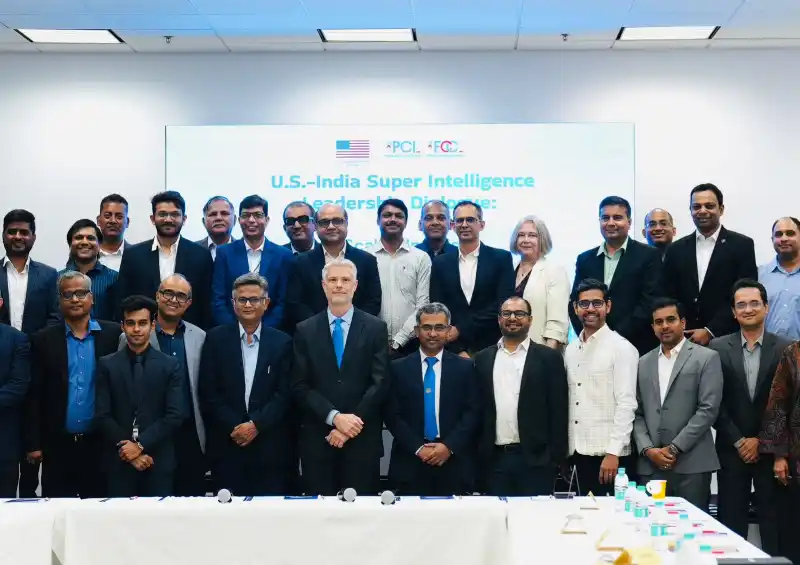
The summit, organised in collaboration with the Payments Council of India (PCI) and the Fintech Convergence Council (FCC), brought together representatives from the US Consulate, the Reserve Bank of India (RBI), and leading fintech and financial institutions. Discussions centred on scaling India’s fintech ecosystem, digital payments, banking technology, artificial intelligence, financial inclusion, credit risk management and India–US technology cooperation.
Krishnakumar was invited to share his views on the future of India’s banking and fintech sectors amid advances in automation, AI, agentic AI and superintelligence.
AI-Based Credit Risk Assessment
Krishnakumar highlighted the need for AI-powered credit risk systems that assess not only a borrower’s credit score and repayment history but also their likely financial position over the next five to ten years.
Currently, banks and financial institutions largely rely on credit scores, past repayment records, salaries, employment status, income and existing financial liabilities when evaluating loan applications. These assessments primarily reflect a person’s past financial behaviour and present circumstances.
He proposed incorporating potential changes in employment, income, expenses and repayment capacity into long-term credit assessments. For instance, when evaluating a long-term loan application from an IT professional, lenders could consider how AI and automation might affect the person’s employment prospects and income in the coming years.
Similarly, technological changes in the automobile sector could influence employment in vehicle maintenance, insurance and related industries. Such factors could form part of forward-looking financial risk assessments.
Although these predictions may not be completely accurate, AI could help lenders identify potential financial risks earlier and make more informed lending decisions.
Preventing Bad Loans Through Proactive Customer Support
Another key proposal focused on improving customer support after a loan is disbursed. Many financial institutions concentrate on EMI reminders and recovery procedures when borrowers miss payments. Krishnakumar argued that banks should instead identify signs of financial stress before repayment defaults occur.
AI-powered systems could provide early warnings and financial guidance when customers experience reduced income, job losses, rising essential expenses or increasing pressure on their repayment capacity.
Rather than using technology primarily to recover outstanding loans, financial institutions should use AI to help borrowers overcome financial difficulties before they become defaulters.
Banking That Supports Financial Growth
Krishnakumar also called for a more customer-centric approach to financial planning. When a borrower receives a salary increase or promotion, banks should not view it solely as an opportunity to offer additional credit.
Instead, they could recommend ways to use the additional income to reduce the tenure of existing loans, make extra EMI payments, lower interest costs or increase savings.
For example, if a borrower has ten years remaining on a loan, financial guidance could help assess whether increased income would make it possible to repay the loan within six years.
Banks could also help customers plan major purchases by considering the full cost of ownership, including fuel, maintenance, insurance and other expenses, rather than focusing only on monthly instalments.
Such services could transform banks from lending institutions into long-term financial partners that support customers’ financial well-being.
Responsible AI and Financial Inclusion
According to Krishnakumar, the next phase of banking technology should move beyond processing existing information towards evaluating future financial possibilities.
Systems that combine income trends, cash flows, financial liabilities, employment developments and individual financial goals could provide personalised financial guidance.
However, he emphasised the importance of customer consent, data privacy, security, lawful data collection and transparency in AI-driven decisions.
Predictive risk assessment and timely customer assistance could help banks and non-banking financial companies (NBFCs) manage bad loans more effectively. These measures could be particularly valuable for small business owners, self-employed individuals, rural households and people with irregular incomes.
By identifying financial stress early and directing customers towards financial counselling, loan restructuring and savings planning, lenders could contribute to a more responsible financial ecosystem.
The central idea behind this approach is that the financial security of customers and the financial stability of lending institutions are closely connected.
Krishnakumar K.T. is the Chairman and Managing Director of Olivia Grameen Credits, a Kerala-based non-banking financial company. He has nearly two decades of experience in banking and financial services, with a focus on rural financial services, financial inclusion and entrepreneurship development.
