


India’s railway wheel manufacturing industry is set for a major transformation as large private sector investments enter a space that has traditionally been dominated by public sector manufacturers. New projects by companies like Jupiter Wagons and the Titagarh Rail Systems-Ramkrishna Forgings joint venture are expected to strengthen domestic production over the next few years and could help India become a net exporter of railway wheels.
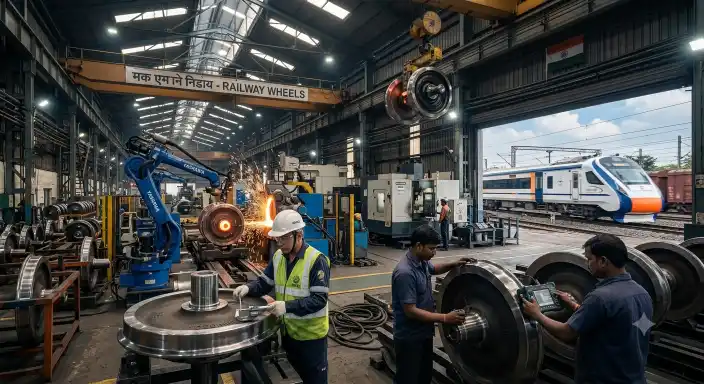
Currently, railway wheel production is largely led by public sector units, including Indian Railways’ Rail Wheel Factory (RWF), which produced a record 2.10 lakh wheels and 1.20 lakh wheelsets in FY26. The Rail Wheel Plant in Bela and SAIL’s Durgapur Steel Plant also contribute to domestic manufacturing.
Among private players, Jupiter Wagons is currently the only company supplying wheelsets, with its Chhatrapati Sambhajinagar facility producing around 2,000 wheelsets every month.
India has historically depended on imports for advanced railway wheels, especially those used in high-speed passenger trains, metro coaches and modern rolling stock such as Vande Bharat trains. The country imported over 50,000 wheelsets from China last year, highlighting the need for stronger domestic manufacturing capabilities.
Jupiter Wagons is now setting up an integrated railway wheel manufacturing facility in Odisha with an annual capacity of around 1 lakh wheelsets. With technology partnerships involving Slovakia’s Tatravagonka and Italy’s Lucchini RS, the company plans to export nearly 50-60% of its production and reduce India’s dependence on imports.
The facility’s axle manufacturing line is expected to begin operations by the end of this year, while the complete railway wheel manufacturing unit is scheduled to become operational in the third quarter of the next financial year.
Meanwhile, Titagarh Rail Systems and Ramkrishna Forgings have established a forged railway wheel manufacturing facility in Chennai through a ₹2,000 crore joint venture. The plant is expected to produce around 2.28 lakh forged wheels annually, with Indian Railways committed to procuring 80,000 wheels every year. The remaining production will be targeted for export markets.
The growing demand for railway infrastructure is driving interest in this sector. Indian Railways requires around 4.4 lakh wheels annually for manufacturing and maintenance of rolling stock, while future demand is expected to rise further with the expansion of freight wagons, passenger coaches, metro networks and Vande Bharat trains.
Experts believe that India’s strong steel industry, availability of raw materials, growing railway network and access to global technology could help the country move from being a railway wheel importer to a global manufacturing hub.
With private companies investing in large-scale facilities, India’s railway wheel industry is entering a new phase focused on self-reliance, advanced manufacturing and global exports.
