


India’s ambitious Gaganyaan human spaceflight mission is moving closer to its first launch as ISRO completes several important tests and preparations. The Centre informed Parliament that most critical technologies required for the mission have been developed and successfully tested.
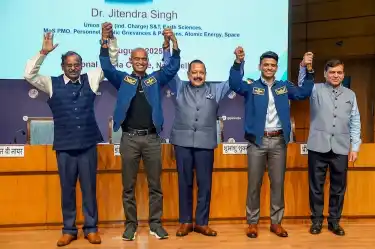
Union Minister of State for Space Dr Jitendra Singh said that the development and ground testing of the human-rated launch vehicle have been completed. The propulsion systems for both the Crew Module and Service Module have also been developed and tested successfully.
Gaganyaan is India’s first mission to send astronauts into space using an indigenous spacecraft. The mission aims to demonstrate India’s ability to safely carry humans to low Earth orbit and bring them back to Earth.
Several major milestones have already been achieved as part of the programme. These include the successful Test Vehicle mission TV-D1, which tested the Crew Escape System designed to protect astronauts during emergencies. ISRO has also completed qualification tests for the Crew Module, Service Module and parachute recovery systems.
Other important activities, including environmental tests, software simulations and propulsion system tests, have either been completed or are in advanced stages.
The four Indian Air Force pilots selected as astronauts for the mission have completed their basic training in Russia. Their specialised mission training for Gaganyaan is yet to begin.
Before astronauts travel into space, ISRO will conduct multiple uncrewed missions to test the spacecraft, launch vehicle and recovery systems. The first uncrewed orbital mission will be followed by additional demonstration flights before the final crewed mission.
The government has expanded the Gaganyaan programme to include eight missions, covering uncrewed flights, crewed missions and future missions connected to India’s planned Bharatiya Antariksha Station.
India’s first crewed Gaganyaan mission is currently targeted for the first quarter of 2027, depending on the successful completion of all required tests.
The successful completion of Gaganyaan will make India the fourth country after Russia, the United States and China to independently achieve human spaceflight capability.
The mission is also expected to support advancements in areas such as robotics, life-support technology, advanced materials, electronics and space manufacturing. It will strengthen India’s space ecosystem by encouraging participation from industries and startups.
Gaganyaan will also serve as a foundation for India’s future space ambitions, including plans to establish the Bharatiya Antariksha Station by 2035 and send an Indian astronaut to the Moon by 2040.
