


Economic cooperation emerged as a major pillar of the partnership, with both leaders welcoming the recently concluded India–New Zealand Free Trade Agreement (FTA).
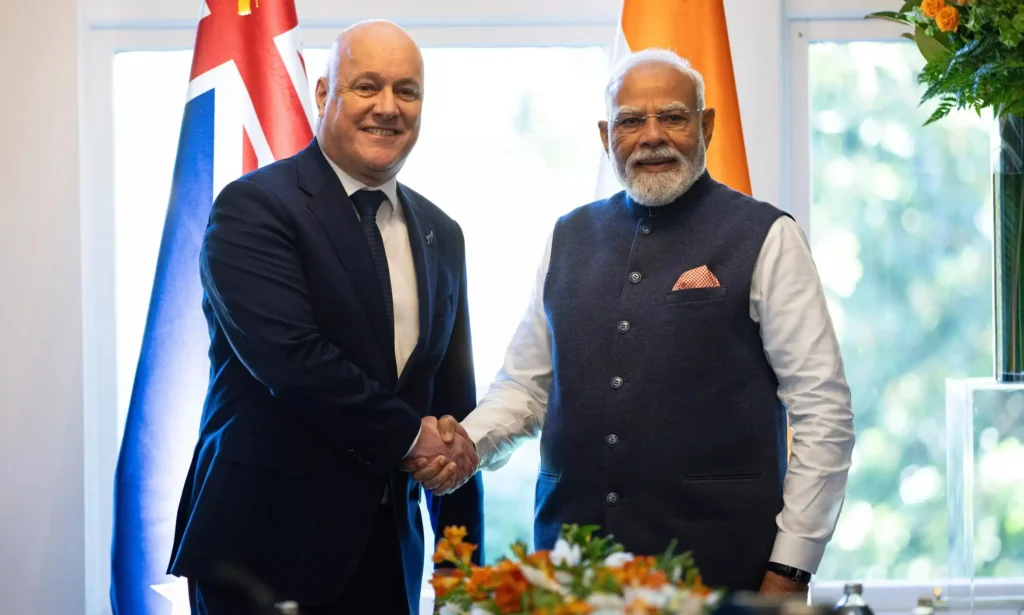
The agreement is expected to expand market access, encourage investments, boost services trade and improve talent mobility between the two countries.
Prime Minister Modi noted that bilateral trade has grown by more than 50% over the past three years and said the FTA would lay the foundation for achieving the 2030 trade target.
New Zealand also announced a NZD 20 billion investment commitment in India, opening new opportunities across infrastructure, agriculture, dairy, food processing, fintech and clean energy.
Defence And Maritime Cooperation Strengthened
The two nations significantly expanded defence cooperation through a series of new agreements, including a Maritime Cooperation Arrangement, an Implementing Arrangement on Hydrography and Nautical Cartography, and a Mutual Logistics Support Arrangement focused on maritime operations.
India and New Zealand also agreed to institutionalise regular engagement between their defence establishments and launch an Annual Maritime Security Dialogue to strengthen coordination, information sharing and joint naval exercises.
The leaders highlighted existing cooperation under Combined Task Force 150, where India and New Zealand have worked together on maritime security and counter-narcotics operations.
Joint Working Group On Counter-Terrorism
Counter-terrorism featured prominently in the discussions, with both countries announcing the establishment of a Joint Working Group on Counter-Terrorism.
The mechanism will facilitate intelligence sharing, cooperation against terror financing, capacity building and efforts to combat organised crime, cybercrime, drug trafficking and human trafficking.
Both leaders reaffirmed their commitment to a zero-tolerance approach towards terrorism.
Shared Vision For The Indo-Pacific
Prime Minister Modi and Prime Minister Luxon reiterated their support for a free, open and rules-based Indo-Pacific, emphasising freedom of navigation and adherence to international law under the United Nations Convention on the Law of the Sea (UNCLOS).
The leaders also called for reforms of the United Nations and reiterated New Zealand’s support for India’s candidature for permanent membership in an expanded UN Security Council.
Expanding Cooperation Across Sectors
Beyond trade and security, India and New Zealand agreed to deepen collaboration in digital payments, including exploring UPI connectivity, agriculture, dairy, food processing, agri-tech, clean energy, urban mobility, water management and innovation.
The two countries also emphasised the importance of building resilient supply chains and strengthening regional energy security, particularly for Indo-Pacific and Pacific Island nations.
With the Strategic Partnership now in place, both governments committed to implementing the Roadmap to 2030 through regular ministerial dialogues and follow-up mechanisms, signalling a new phase in India-New Zealand relations centred on economic growth, strategic cooperation and regional stability.
