


Jio Platforms, the digital services arm of Reliance Industries, has cleared a key milestone in its journey toward a public listing, with its board approving the Draft Red Herring Prospectus (DRHP) for a proposed initial public offering.
According to a filing with the BSE, the IPO will comprise a fresh issue of up to 27 crore equity shares with a face value of ₹10 each. The final price will be decided through the book-building process in line with SEBI regulations, and the issue will proceed only after receiving the necessary regulatory approvals.
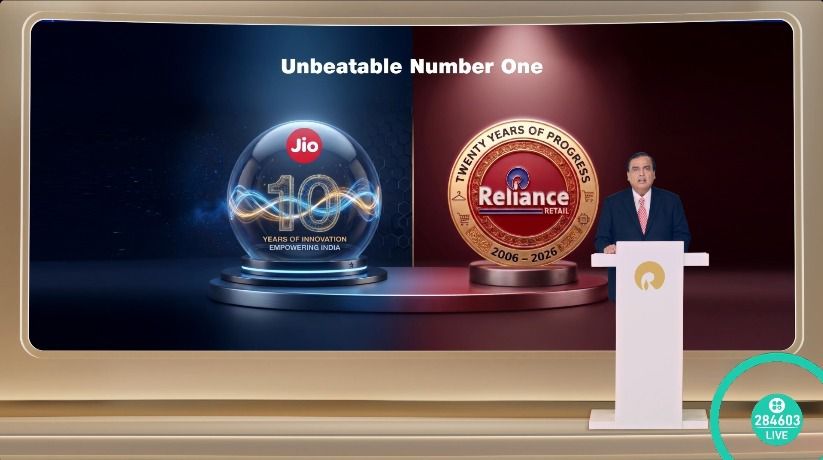
Reliance Chairman Mukesh Ambani confirmed the development during the company’s 49th Annual General Meeting, stating that the DRHP would be filed with SEBI on the same day. He also highlighted that Reliance Industries holds a 66.43% stake in Jio Platforms, while Meta and Google together own 17.71% of the remaining equity.
Market expectations around the IPO are already high. Analysts estimate that Jio Platforms could be valued between $130 billion and $180 billion, potentially making it the largest IPO in India’s history. While the company has not disclosed the issue size, reports suggest it could be around $4 billion. The listing is being closely watched alongside other major expected offerings, including the National Stock Exchange’s proposed ₹30,000 crore IPO.
The move comes amid a global surge in large technology listings, driven by investor interest in digital infrastructure, artificial intelligence, and platform-based businesses. Markets worldwide are tracking high-profile debuts in the tech sector, reinforcing the strong demand for digital economy assets.
Alongside the IPO announcement, Reliance Industries reported its strongest-ever financial performance for FY26. The company posted record revenue, EBITDA, and net profit despite a challenging global environment. Consolidated revenue stood at ₹11,75,919 crore ($124 billion), up 9.8% year-on-year.
The company’s EBITDA rose sharply over five years, increasing from ₹97,580 crore in FY21 to ₹2,07,911 crore ($21.9 billion) in FY26, reflecting strong operational expansion. Retail and digital businesses played a central role in this growth, together contributing nearly half of the group’s EBITDA and emerging as key future growth engines.
Net profit for FY26 reached ₹95,754 crore ($10.1 billion), marking a 17.8% increase over the previous year. Reliance also continued its aggressive investment cycle, with capital expenditure of ₹1,44,271 crore ($15.2 billion) during the year. Over the past five years, total capex reached ₹6,48,428 crore ($68.4 billion), making Reliance one of India’s largest investors by scale.
The company remained a major contributor to the Indian economy. Exports stood at ₹2,78,808 crore, accounting for 6.7% of India’s merchandise exports. It also contributed ₹2,16,472 crore to the national exchequer in FY26, taking its five-year contribution past ₹9.78 lakh crore.
On the social responsibility front, Reliance reported ₹2,248 crore in CSR spending, the highest by any Indian company during the year. The company said its financial strength is supported by disciplined capital allocation, risk management, and strong cash flows, reflected in improved global credit ratings from S&P (A-) and Moody’s (Baa1), both above India’s sovereign rating.
Reliance also highlighted its role as a major employment generator, with its retail and digital businesses creating large-scale direct and indirect jobs and enabling widespread micro-entrepreneurship across the country.
Overall, the developments signal two parallel stories: the rapid scaling of Jio Platforms toward a landmark IPO and Reliance Industries’ continued expansion as a diversified powerhouse driving growth across India’s digital and consumer economy.
