


Telangana Chief Minister A. Revanth Reddy used the 11th NITI Aayog Governing Council meeting to present an education-led development model for the state, arguing that quality education and healthcare are essential pillars for achieving the vision of a developed India by 2047.
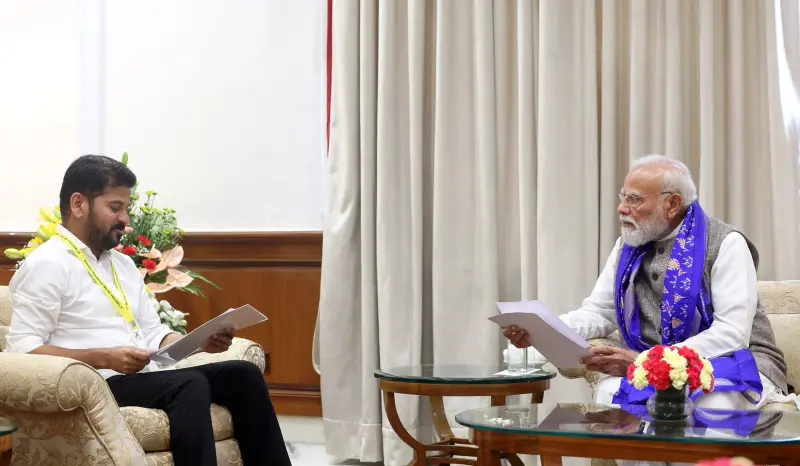
Drawing on findings from Telangana’s 2024 Social, Economic, Educational, Employment, Political and Caste (SEEEPC) survey, which covered 3.55 crore people across 242 castes, the chief minister said lack of education remains the primary driver of social backwardness. He emphasized that Telangana’s future economic strategy would be built around the survey’s findings.
Revanth highlighted initiatives such as English-medium instruction in government schools, digital classrooms, free meals, transportation facilities, and the proposed Young India Schools aimed at improving educational outcomes and promoting social equality.
The chief minister also unveiled the state’s “Telangana Rising” vision, targeting a $1 trillion economy by 2034 and a $3 trillion economy by 2047. To support this ambition, he sought the Centre’s cooperation for major infrastructure, education, and industrial projects.
Among the proposals placed before the Centre were the expansion of Hyderabad Metro Phase II, the Regional Ring Road, Bharat Future City, approvals for the Palamuru-Rangareddy Lift Irrigation Scheme, support for semiconductor manufacturing, and the establishment of an Indian Institute of Management (IIM) in Hyderabad.
Revanth also proposed the creation of an “M-6 Task Force” under the Prime Minister’s Office to accelerate the development of six major economic hubs, Delhi, Mumbai, Kolkata, Chennai, Hyderabad, and Bengaluru, and sought a dedicated ₹6 lakh crore infrastructure fund for these cities.
