


India generates between 150 and 500 million tonnes of construction and demolition (C&D) waste annually, contributing to air and water pollution, heavy metal contamination, CO2 emissions, and overburdened landfills. Traditional construction waste recycling remains limited, worsening the environmental impact.
Megha Rathee, co-founder of Delhi-based startup Vishwa Hara Chakra, explains that India produces around 400 million tonnes of cement and 200 billion bricks each year, which, while essential for urbanization, depletes resources and emits significant carbon. Founded in 2024, Vishwa Hara Chakra focuses on eliminating cement and creating carbon-negative, socially conscious, and technologically advanced construction solutions.
Megha’s background in education and institution-building gave her the skills in systems, discipline, and long-term impact that helped translate her sustainability passion into a practical, climate-focused startup. A chance meeting with sustainability expert Professor Ashwin Gopinath led them to explore waste management, circular economy principles, and urban infrastructure solutions. They conducted research on India’s construction waste and developed methods to transform it into usable, carbon-negative construction materials, forming the foundation of the startup.
The team later expanded to include Abhishek Chhazed, a climate-tech entrepreneur, and Lt. General (Retd.) J.S. Nain, who brings over four decades of military experience and mentorship to the advisory board. The startup was bootstrapped with Rs 25 lakh from the founders’ savings and later raised additional family funding.
Vishwa Hara Chakra addresses the environmental impact of traditional construction materials, which contribute more than 10% of global CO2 emissions. Its Eco-Concrete technology uses industrial waste like fly ash and slag to create cement-free bricks, drastically reducing carbon emissions while maintaining structural integrity. Conventional cement emits roughly 80 grams of CO2 per kg, whereas Eco-Concrete eliminates cement entirely.
The startup also developed Zephyr Insulation, a high-performance solution for water tanks, pipelines, and buildings in extreme cold regions, preventing freezing, reducing energy use, and protecting infrastructure from freeze-thaw damage. Additionally, the company runs a waste-to-energy initiative producing Compressed Bio-CNG from agricultural and municipal waste.
Despite early skepticism from industry leaders, the credibility and expertise of the founding team helped secure their first major order: a Rs 1.8 crore project for TATA at the Noida International Airport.
Today, Vishwa Hara Chakra operates across three main areas: sustainable building materials (blocks, pavers, tiles), advanced insulation materials, and waste-to-energy solutions. Eco-Concrete reduces carbon emissions by 80% compared to traditional cement, with less than 1% waste in manufacturing. Zephyr Insulation cuts heat loss by 60–80% in water tanks and up to 70% in pipelines, crucial for high-altitude, sub-zero regions like the Himalayas, including Indian Army installations.
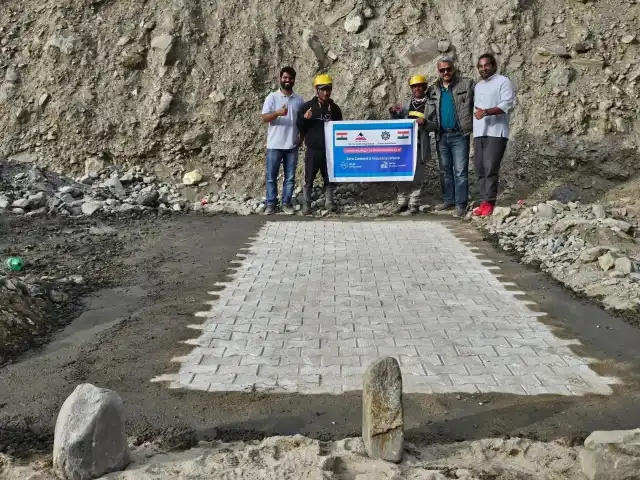
The startup has worked with prominent clients including TATA, ITDC, the Adani Group, MES, Border Road Organization, and NBCC, and has completed projects in Kargil and Rohtang Pass. Since its founding, Vishwa Hara Chakra has generated Rs 5 crore in revenue. The team plans to expand Zephyr Insulation and other sustainable building solutions, focusing on extreme climate regions across India, including Bikaner and Jaisalmer.
