


The government is set to transform India’s shipbuilding sector by offering land at near-zero cost to shipyards, aiming to attract global investment, reduce operational expenses, and strengthen India’s position in the maritime industry. The initiative is expected to drive sustainable growth in coastal states.
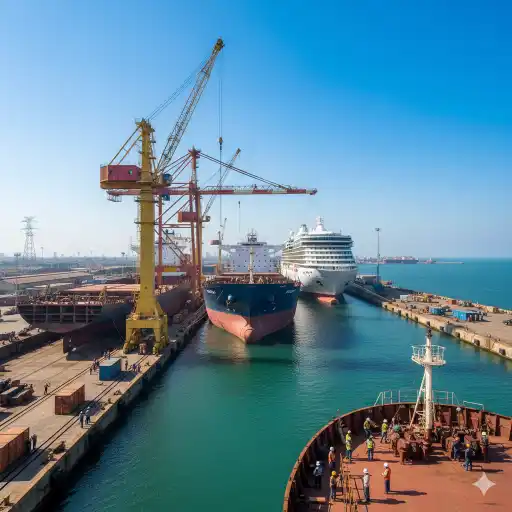
Under the new greenfield shipbuilding cluster development scheme, shipyards investing in new construction and repair facilities within designated industrial corridors may receive land almost free of cost. The ports and shipping ministry has proposed leases of up to 60 years, extendable further, with only nominal rent charged. The land cost itself will not be included in lease agreements.
Shipbuilding companies, particularly global players, have long cited land availability and associated infrastructure as critical for greenfield investments. By absorbing land costs, the government reduces the upfront investment and operational risks, making India more competitive compared to existing shipbuilding hubs like China, South Korea, and Vietnam.
A single greenfield shipyard with an annual capacity of around 0.5 million gross tonnage (GT) would require an estimated ₹15,000 crore. The scheme envisions three to four clusters in coastal states, with only one cluster per state and each cluster capable of producing roughly 1.2 million GT. Earlier reports indicate a plan to attract ₹75,000 crore in investments across these clusters, with India exploring partnerships with Japan and South Korea.
Land for the clusters will be transferred to a special purpose vehicle (SPV), either jointly owned by state and central governments or fully by the central government. The SPV will develop and maintain common infrastructure, including internal roads, rail spurs, utilities, and maritime assets, while attracting investments from shipyards and ancillary industries. Individual shipyards will invest in yard-specific infrastructure and pay nominal lease fees to the SPV.
Industry experts have welcomed the scheme. Pushpank Kaushik, CEO at Jasper Shipping, noted that the high capital cost and difficulty in acquiring land had long been barriers for shipbuilding in India. With government support and infrastructure incentives, India’s competitiveness is expected to improve significantly.
The clusters are planned to cover 2,000 acres each, with 1,000 acres for shipyards and the remaining for ancillary industries and institutions. Anchor shipyards must achieve a design capacity of at least 0.5 million GT per year within ten years and cannot repurpose the facility for non-shipbuilding uses without prior approval.
Currently, India has a shipbuilding capacity of only about 100,000 GT. According to the Maritime Amrit Kaal Vision 2047 (MAKV 2047), India aims to rank among the top 10 in ship ownership and shipbuilding by 2030 and among the top five by 2047. By 2047, the country plans to increase Indian-flagged ship ownership sevenfold to 100 million GT and shipbuilding output 40-fold to 4.5 million GT, signaling a long-term strategy to become a global maritime manufacturing and logistics leader.
