


India and Vietnam held the fifteenth Defence Policy Dialogue in Hanoi on November 10, with India represented by Defence Secretary Rajesh Kumar Singh and Vietnam by Lieutenant General Hoang Xuan Chien. The meeting focused on strengthening defence cooperation and produced two major agreements. Both sides reviewed regional and global developments and noted that the friendship and broad cooperation between them has grown steadily since the Comprehensive Strategic Partnership was announced in 2016.
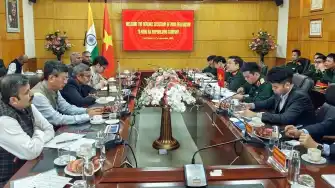
Defence ties already cover delegation exchanges, young officer programs, training, peacekeeping and defence industry work. Vietnam continues to follow an independent foreign policy shaped by self reliance, peace and cooperation, and remains committed to resolving South China Sea issues through peaceful means under international law, including UNCLOS.
During the dialogue, both countries agreed to sustain high level visits, keep consultation mechanisms active, widen cooperation in areas like training, UN peacekeeping and defence production, and make use of credit and grant assistance. They also identified future possibilities in cybersecurity, military medicine and search and rescue. Vietnam supports India’s growing cooperation with ASEAN, including through ADMM Plus, and India considers defence cooperation a key pillar of its partnership with Vietnam.
The bilateral exercise VINBAX 2025, which opened on November 11, adds to this momentum. The two new agreements signed at the dialogue mark a significant step forward. The first is a Memorandum of Agreement on mutual submarine search and rescue support, which sets up formal coordination for submarine emergencies and improves naval interoperability. The second is a Letter of Intent on defence industry cooperation that enables technology transfer, joint production, expert exchanges and design collaboration under India’s Make in India effort and Vietnam’s modernisation goals.
These agreements point to a deeper level of maritime safety cooperation, a stronger defence industrial base and greater strategic alignment between the two countries. Both sides also reviewed progress in hydrography, ship visits, capacity building, peacekeeping and emerging areas such as AI and shipyard upgrades. These conversations gain extra weight given the wider competition in the Indo Pacific maritime space.
The new agreements also carry regional implications. They help move bilateral defence ties into concrete operational and industrial projects, support a stable maritime order and signal diversified partnerships and greater self reliance. At the same time, implementation will not be simple. Submarine rescue requires specialised skills and shared protocols. Industry projects often face challenges related to exports, intellectual property and cost sharing. Regional tensions could create additional complications, and high level agreements need regular follow through to stay effective.
To get the most out of these agreements, both sides need quick action plans, including joint working groups, coordinated naval exercises, clear targets in high tech domains and mid term reviews ahead of the next dialogue in 2026. There is also scope to involve public and private defence sectors and to use ASEAN and Indo Pacific forums to widen the impact.
The dialogue reaffirmed the central role of defence in India Vietnam relations and the shared commitment to an open and inclusive maritime order. Officials discussed upcoming visits, staff talks, training programs and expanded joint exercises. The meeting also fit into the broader context of India’s engagement with ASEAN, shown recently by Defence Minister Rajnath Singh’s participation in the ADMM Plus meeting in Malaysia. Within this larger regional strategy, Vietnam continues to be a pivotal partner in India’s Act East policy.
