


Jindal Steel plans to invest an additional ₹15,000 crore by 2035 to expand its manufacturing facilities at Angul in Odisha and Raigarh in Chhattisgarh. The investment will support the company’s ambition to increase its combined steelmaking capacity from the current 15.5 million tonnes per annum (MTPA) to 20 MTPA in phases.
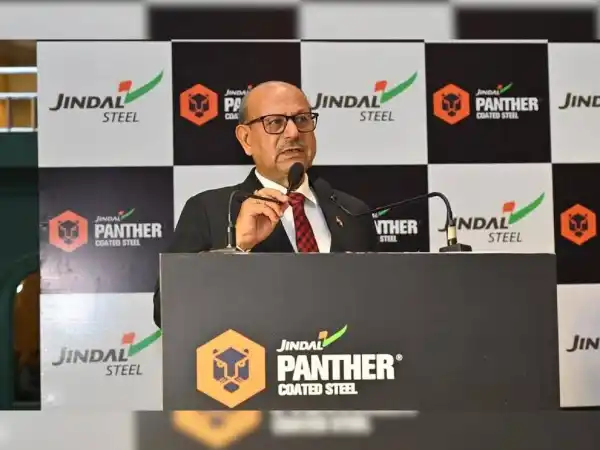
The company will fund the expansion through internal accruals rather than fresh bank loans. Managing Director V R Sharma said Jindal Steel would follow an ‘earn and invest’ approach, reinvesting annual savings into capital expenditure.
Capacity Expansion at Angul and Raigarh
Jindal Steel currently has a production capacity of 12 MTPA at its Angul facility and 3.5 MTPA at Raigarh. The proposed expansion will add 4.5 MTPA in phases, taking the combined capacity to 20 MTPA.
The company has already completed its earlier ₹21,000 crore capital expenditure programme, which was planned during the Covid period. The new investment marks its next phase of manufacturing expansion, with a focus on cautious capital deployment.
Jindal Panther Enters Coated Steel Market
Alongside the investment announcement, Jindal Steel launched Jindal Panther Coated Steel, expanding its established Jindal Panther brand into colour-coated steel, bare metallic-coated steel and specialised building products.
The portfolio includes India’s widest 1,650-mm coated steel offering. The products will be manufactured at the Angul plant and are designed for applications such as roofing, cladding, industrial buildings, commercial spaces and residential construction.
Infrastructure and Warehousing to Drive Demand
Jindal Steel expects demand for coated and value-added steel to grow across industrial construction, warehousing and infrastructure projects.
Large industrial facilities, modern foodgrain storage warehouses and silos are expected to create demand for colour-coated and galvanised steel. Railway infrastructure, new railway stations and cross-country pipelines are also emerging as potential growth areas.
The company sees the shift towards value-added steel as an opportunity to strengthen its downstream business and develop products that can substitute imports as India’s steel consumption expands.
