


The Centre is preparing new safety standards for e-rickshaws modelled on India’s Bharat New Car Assessment Programme (Bharat NCAP), Union Road Transport and Highways Minister Nitin Gadkari announced on November 17, 2026.
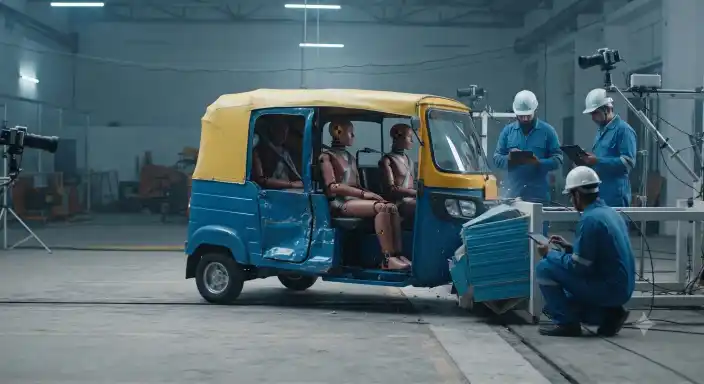
The proposed framework aims to improve safety in the electric three-wheeler segment, which has become an important part of India’s last-mile transport network. E-rickshaws are widely used for short-distance passenger movement in cities and smaller towns, but concerns over vehicle quality and passenger protection have continued to draw attention.
Speaking at the Bharatiya Yuva Shakti Trust (BYST) JRD Tata Awards 2026, Gadkari said the government was working on safety standards similar to those used for passenger cars under Bharat NCAP.
“We are preparing safety standards for e-rickshaws on the lines of Bharat NCAP to enhance road safety measures,” he said.
Bharat NCAP model for e-rickshaws
Introduced in 2023, Bharat NCAP is India’s independent vehicle safety assessment programme. It evaluates passenger cars through crash tests and awards ratings ranging from one to five stars based on their ability to protect adult and child occupants during collisions.
The proposed e-rickshaw framework is expected to establish safety benchmarks for electric three-wheelers. However, the government has not yet disclosed the testing procedures, assessment criteria, rating system or implementation timeline.
The announcement comes amid growing use of electric three-wheelers for passenger transport and last-mile connectivity. A formal safety assessment framework could bring greater focus to vehicle design, manufacturing quality and passenger protection.
India records nearly five lakh road accidents annually
Gadkari highlighted the scale of India’s road safety challenge, stating that the country records nearly five lakh road accidents every year, resulting in around 1.8 lakh deaths, according to road ministry data.
He reiterated that improving road safety remains a priority for the government.
Gadkari sets employment and automobile industry targets
The minister also outlined the government’s employment generation ambitions, saying it aims to create opportunities for 12 crore young people over the next two to three years.
He said India should also aim to become the world’s largest automobile industry within five years. According to Gadkari, the Indian automobile industry’s value has grown from ₹14 lakh crore when he took charge as transport minister to approximately ₹22 lakh crore.
He placed India third globally, behind the US, valued at ₹78 lakh crore, and China, at ₹47 lakh crore.
Highway monetisation could generate ₹15 lakh crore
Gadkari also discussed infrastructure financing, stating that monetisation of highway projects could generate at least ₹15 lakh crore for the road sector.
He said the ministry had sufficient financial resources for highway development but faced challenges in utilising the available funds effectively.
The proposed e-rickshaw safety framework is part of the government’s broader focus on improving road safety while supporting the growth of India’s automobile and electric mobility sectors.
