


India’s upcoming Tejas Mk2 and the modernised F-16V represent two different approaches to developing advanced fighter aircraft. While Tejas Mk2 is being developed as a new Indian medium-weight 4.5-generation fighter, the F-16V builds on the established F-16 platform with upgraded radar, avionics, sensors and weapons systems.
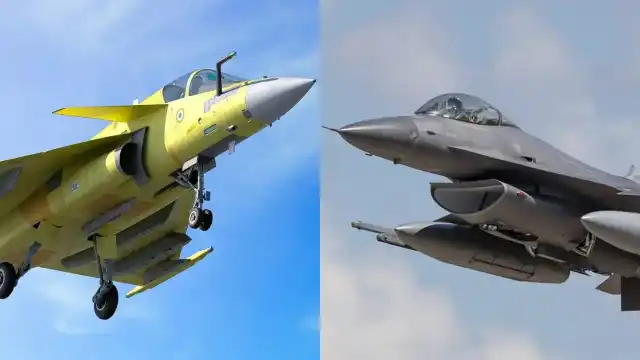
For India, the comparison is significant as Tejas Mk2 is expected to offer higher payload capacity, a more powerful engine and greater use of indigenous technologies.
Tejas Mk2 Is a Larger Fighter
The Tejas Mk2 is being developed as a medium-weight fighter with a planned maximum take-off weight of around 17.5 tonnes and a payload capacity of about 6.5 tonnes.
The aircraft features a redesigned fuselage with extensive carbon-fibre composite construction and close-coupled canards. Its larger airframe provides additional space for fuel, weapons and electronic systems, marking a significant increase in size and capability over the Tejas Mk1 and Mk1A.
The F-16V retains the basic Falcon design and is comparatively smaller in physical dimensions. Lockheed Martin lists the Block 70/72 version with a maximum take-off weight of about 21.8 tonnes and a maximum speed of Mach 2 or above.
Maximum take-off weight, however, does not by itself determine an aircraft’s overall capability, as both fighters are designed around different combinations of fuel, payload and onboard systems.
Engine Power
Tejas Mk2 is planned to be powered by the General Electric F414 engine, which offers substantially higher thrust than the engine used by the earlier Tejas variants.
India and GE have also reached an agreement for manufacturing F414 engines in India with technology transfer. The programme is strategically important for India’s efforts to develop domestic expertise in fighter aircraft production.
The F-16V can be equipped with either the F100 or F110 engine, depending on the customer and aircraft configuration. Block 70/72 specifications place the engine thrust in the 29,000-pound class.
For Tejas Mk2, the F414 programme is important not only for aircraft performance but also for India’s wider aerospace manufacturing ambitions.
Both Fighters Feature AESA Radar
The F-16V comes with Northrop Grumman’s APG-83 Active Electronically Scanned Array radar. The system provides improved situational awareness, target tracking and engagement capabilities compared with earlier F-16 radar systems.
The APG-83 also incorporates technologies developed for more advanced American fighter aircraft, including the F-35 and F-22 programmes.
Tejas Mk2 is planned to use India’s Uttam AESA radar, developed by the Defence Research and Development Organisation. Uttam is designed as a scalable radar system whose configuration can be adapted according to the aircraft’s requirements.
A major difference is the maturity of the two systems. The APG-83 is already operational on F-16 variants, while Uttam will need to complete integration and testing with Tejas Mk2.
Sensor and Electronic Systems
The F-16V features an upgraded cockpit, modern displays, targeting-pod integration and advanced electronic systems. The aircraft can also be equipped with infrared search and track technology for detecting and tracking airborne targets.
Tejas Mk2 is also planned to feature an advanced sensor suite, including Uttam AESA, an infrared search and track system and electronic warfare equipment.
While both aircraft are designed around modern sensor technologies, the F-16V benefits from the integration experience gained through decades of development and operation of the F-16 family.
F-16V Has Extensive Weapons Integration
One of the F-16V’s major strengths is the extensive weapons integration developed over the aircraft family’s long service history.
Lockheed Martin says the F-16 has accumulated thousands of certified carriage and release configurations covering more than 180 weapon and store types. This gives operators significant flexibility in selecting missiles, bombs, targeting pods and other systems.
Tejas Mk2 is being developed alongside India’s expanding indigenous weapons ecosystem. The aircraft is expected to integrate Indian systems such as the Astra missile and other locally developed weapons, with 11 hard points planned.
Greater integration of Indian weapons could provide India with more control over future upgrades and reduce dependence on foreign suppliers.
Indigenous Technology Is a Key Focus
For India, Tejas Mk2 represents more than the development of another fighter aircraft. The programme is part of a broader effort to build domestic capabilities in aircraft design, radar technology, electronic warfare, weapons and engine manufacturing.
The government has sanctioned more than ₹9,000 crore for the development of Tejas Mk2, while efforts are also underway to increase indigenous content across the fighter programme.
The F-16V, in contrast, is based on an established US-designed platform supported by a mature international supply chain.
F-16V Has Decades of Experience
The F-16 family has been in service since the 1970s and is operated by air forces around the world. This gives the F-16V an extensive operational record that Tejas Mk2 does not yet have.
According to Lockheed Martin, more than 3,100 F-16 aircraft are operating across 25 countries, with the fleet having accumulated millions of flight hours.
The Block 70/72 also has an extended structural life of up to 12,000 flight hours, which Lockheed Martin says is more than 50 percent higher than earlier production versions.
Tejas Mk2 is still under development, meaning its planned specifications will need to be validated through flight testing, weapons integration and certification.
Tejas Mk2 Offers Future Growth Potential
Tejas Mk2 has been designed as a new medium-weight fighter rather than as an upgrade of an older airframe.
Its planned 17.5-tonne maximum take-off weight, 6.5-tonne payload, F414 engine, Uttam AESA radar and 11 hard points are intended to provide greater capability and room for future upgrades.
The aircraft is also being developed with modern avionics and electronic warfare systems from the outset.
Different Strengths
The F-16V combines a proven airframe with upgraded radar, avionics, sensors and extensive weapons integration. Its long operational history provides an established record of reliability, maintenance and combat use.
Tejas Mk2 is designed around India’s requirements for a larger medium-weight fighter and greater domestic control over key technologies. Its eventual capabilities will depend on successful development, testing and certification.
The two aircraft therefore represent different stages of fighter development, with the F-16V evolving an established platform and Tejas Mk2 being developed as a new Indian fighter with an emphasis on indigenous technology and future growth.
