


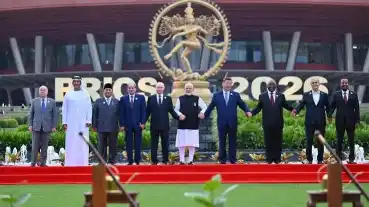
Prime Minister Narendra Modi’s leadership at the 18th BRICS Summit in New Delhi highlighted India’s efforts to promote cooperation, dialogue and inclusive global growth at a time of growing geopolitical tensions. The two-day summit, which concluded on September 13, brought together leaders including Chinese President Xi Jinping, Russian President Vladimir Putin, Iranian President Masoud Pezeshkian and UAE Crown Prince Mohamed bin Zayed Al Nahyan.
BRICS Summit Shows the Importance of Dialogue Amid Global Divisions
The adoption of the New Delhi Declaration at the BRICS 2026 Summit marked a significant diplomatic moment, particularly as member countries continue to face differences over global conflicts, trade and international priorities.
With the Russia-Ukraine war continuing, instability in West Asia and changing US tariff policies adding to uncertainty, the summit took place against a difficult global backdrop. These developments have affected international trade, businesses, supply chains and the broader prospects for peace and stability.
Despite these challenges, the India-hosted summit demonstrated that countries with differing positions could still come together and work towards common goals.
Prime Minister Narendra Modi, in his concluding address, called on BRICS to respond to global challenges through cooperation and inclusive growth. He also warned against the weaponisation of technology and critical minerals, saying such developments could undermine shared prosperity and progress.
Modi Calls for a More Inclusive Global Governance System
One of the key messages from Prime Minister Modi’s BRICS 2026 address was the need to reform the existing global decision-making structure.
Criticising the unequal distribution of influence in international institutions, Modi described the current system as a “pyramid of privilege”. He argued that countries in the Global South often face the greatest impact from global crises while having limited influence over decisions that shape the international order.
The Prime Minister called for this system to be replaced by a “platform of partnership”, where every country has a voice and a stake in global development.
India’s BRICS leadership also emphasised the importance of multilateralism, multipolarity and respect for international law. The summit reinforced the view that BRICS is evolving beyond an annual gathering of emerging economies into a platform through which Global South countries seek a stronger voice in global affairs.
BRICS Challenges the Narrative of a Divided Grouping
The New Delhi Summit gained significance amid repeated criticism of BRICS and threats of higher tariffs against its members from US President Donald Trump.
However, the adoption of a common declaration offered a different picture. Despite disagreements among members, the grouping managed to reaffirm cooperation and the importance of a more balanced international system.
The outcome was particularly relevant at a time when questions are being raised about the effectiveness of global institutions, including the United Nations and the UN Security Council.
The summit showed that BRICS members may not agree on every issue, but they can still work together on areas of shared interest.
Iran-UAE Meeting Highlights the Role of BRICS Diplomacy
An important diplomatic moment during the summit came on September 11, when UAE Crown Prince Sheikh Khaled bin Mohamed bin Zayed Al Nahyan met Iranian President Masoud Pezeshkian at Bharat Mandapam along with their respective delegations.
The two leaders shook hands warmly, drawing attention amid continuing tensions in West Asia.
While the meeting did not resolve the region’s wider conflicts, it demonstrated the value of maintaining communication between countries with differing positions.
India has consistently advocated dialogue and diplomacy as the way forward in resolving international disputes. During the summit, Prime Minister Modi reiterated India’s willingness to support peace efforts.
The Iran-UAE interaction underlined a broader message from the New Delhi Summit: diplomacy does not always require countries to eliminate their differences. Creating opportunities for dialogue can itself be an important step towards stability.
Putin Uses BRICS Platform to Address Russia-Ukraine War
Russian President Vladimir Putin also used the BRICS platform to present Russia’s position on the Ukraine conflict.
Speaking from the summit venue, Putin said Russia did not pose a threat to European countries. At the same time, he warned on September 11 that any deployment of European troops to Ukraine would amount to a “war against Russia”.
His remarks highlighted the continuing geopolitical divisions surrounding the Russia-Ukraine war and the significance of BRICS as a platform for international engagement.
Greater BRICS Cooperation and Global South Development
Chinese President Xi Jinping unveiled initiatives covering areas such as artificial intelligence and trade to deepen cooperation among the expanded BRICS grouping.
The initiatives reflected Beijing’s efforts to strengthen BRICS as a practical platform for development in the Global South.
The summit also focused on strengthening supply chains and improving resilience against disruptions caused by pandemics, climate disasters and other global challenges.
These discussions came at a time when rising geopolitical tensions and restrictions involving technology and critical minerals are creating concerns for global economic stability.
India’s Diplomatic Role Gains Importance
The BRICS 2026 Summit was more than a routine gathering of world leaders. It provided India with an opportunity to demonstrate its diplomatic reach and its ability to bring countries with competing interests together.
Prime Minister Modi’s emphasis on cooperation, inclusive growth and dialogue reflected India’s broader approach to international diplomacy.
The summit also showed that BRICS continues to have relevance despite internal differences. Its members may disagree over wars, trade and geopolitical priorities, but their ability to reach a common declaration demonstrated the importance of keeping communication open.
The New Delhi Summit therefore emerged as a significant moment for India and the Global South, highlighting the need for a global order based on partnership rather than confrontation.
And perhaps the biggest takeaway is simple: when countries with differences still manage to sit together and find common ground, that itself becomes a diplomatic achievement.
