


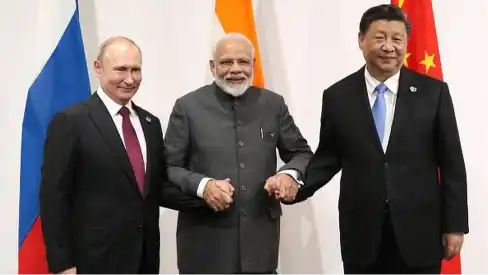
Prime Minister Narendra Modi, Chinese President Xi Jinping, Russian President Vladimir Putin and other world leaders have gathered in Bishkek, the capital of Kyrgyzstan, for the 26th Shanghai Cooperation Organisation (SCO) Summit.
The two-day summit, being held on August 31 and September 1, comes as the SCO marks 25 years since its formation. Leaders are expected to discuss regional security, counter-terrorism, trade, energy, connectivity and digital cooperation.
The conflicts in West Asia and Ukraine, along with wider geopolitical developments, are also expected to feature in the discussions.
Modi Arrives in Bishkek
Modi arrived in Bishkek on Sunday after completing a two-day visit to Uzbekistan. He was received at the airport by Kyrgyzstan’s Chairman of the Cabinet of Ministers Adylbek Kasymaliev and welcomed with a traditional cultural performance.
External Affairs Ministry spokesperson Randhir Jaiswal said the summit brings together the SCO’s 10 member states, 15 partner countries and two observer countries to strengthen dialogue and cooperation on regional and global issues.
Modi is attending the summit at the invitation of Kyrgyz President Sadyr Zhaparov. Before his visit, the Prime Minister said India would work to advance a regional vision based on security, connectivity and opportunity.
He also called for a region free from terrorism, separatism and extremism, describing these threats as major challenges to peace and stability.
Security and Counter-Terrorism
Regional security and counter-terrorism are expected to remain central to the summit agenda.
SCO leaders are likely to address cross-border terrorism, extremism and other forms of transnational crime. The discussions are expected to focus on strengthening cooperation among member countries to deal with emerging security threats.
Trade Connectivity and Energy
Economic cooperation is another major priority for the grouping.
Leaders are expected to explore ways to increase trade, improve cross-border payment mechanisms and strengthen financial cooperation among SCO members.
Connectivity will also receive attention, particularly transport and supply-chain networks linking Central Asia with major regional and global markets.
Energy security, clean-energy cooperation and digital technologies are also expected to feature in the discussions.
The summit is expected to end with the adoption of the Bishkek Declaration, outlining the SCO’s priorities and direction for the coming years.
Modi Xi and Putin in Focus
The presence of Modi, Xi Jinping and Putin has added significance to the summit amid changing geopolitical conditions.
Modi is expected to hold bilateral meetings with Kyrgyz President Sadyr Zhaparov, Putin and other leaders on the sidelines of the summit.
His meeting with Putin is expected to cover the India-Russia strategic partnership, including cooperation in areas such as energy and defence.
Xi is also expected to meet several SCO leaders. His participation has brought India-China relations into focus as New Delhi and Beijing continue efforts to stabilise ties following prolonged tensions along the Line of Actual Control.
Putin is expected to hold separate talks with Xi and Iranian President Masoud Pezeshkian. Other prominent leaders attending the summit include Pakistan Prime Minister Shehbaz Sharif and Turkish President Recep Tayyip Erdogan.
SCO Completes 25 Years
The Shanghai Cooperation Organisation was formally established in 2001 by China, Russia, Kazakhstan, Kyrgyzstan, Tajikistan and Uzbekistan.
India and Pakistan became full members in 2017, followed by Iran in 2023 and Belarus in 2024.
The organisation developed from the Shanghai Five, which was formed in 1996 to address military and border-related concerns involving China, Russia and three former Soviet republics.
The SCO describes itself as a platform for cooperation rather than a military alliance. Its founding declaration states that it is not an alliance directed against other countries.
The organisation now has 10 full members, along with 15 partner countries and two observer states, Afghanistan and Mongolia.
India Focuses on Central Asia
For India, the summit provides an opportunity to strengthen ties with Central Asian countries, particularly in trade, energy and connectivity.
Bilateral meetings on the sidelines are also expected to provide opportunities to advance India’s strategic and economic cooperation with Russia and other SCO members.
During his Kyrgyzstan visit, Modi will also attend the opening ceremony of the 6th World Nomad Games.
Kyrgyzstan currently holds the rotating SCO chairmanship. At the end of the summit, the chairmanship is expected to pass to Pakistan, which will lead the organisation through 2027 and host the next SCO leaders’ summit.
