


Lakshadweep has prepared a five-year strategic plan to significantly expand its fisheries sector, with the goal of increasing annual tuna and tuna-like fish production to 50,000 tonnes, more than double the current catch levels.
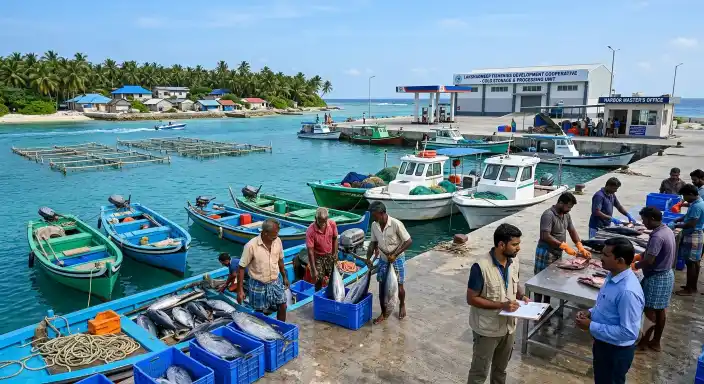
The roadmap focuses on improving livelihood opportunities for island fishing communities by expanding deep-sea tuna fishing, promoting mariculture, developing seaweed farming and strengthening fisheries infrastructure.
The plan was discussed during a stakeholder consultation held at the ICAR-Central Marine Fisheries Research Institute (CMFRI). The meeting brought together officials from the Union Fisheries Department, Lakshadweep Fisheries Department, National Fisheries Development Board (NFDB), CMFRI, Central Institute of Fisheries Technology, Marine Products Export Development Authority (MPEDA), fisheries entrepreneurs, fishermen and representatives of fishermen’s cooperative societies.
The perspective plan will guide fisheries development in Lakshadweep under the Pradhan Mantri Matsya Sampada Yojana (PMMSY), with focus areas including marine fisheries, mariculture, post-harvest management, value addition, marketing, infrastructure development, skill building and entrepreneurship.
Among the key proposals are the introduction of 50 new deep-sea fishing vessels below 24 metres, seaweed cultivation across five square kilometres and the establishment of 10 medium-scale ornamental fish rearing units.
The plan also highlights the potential of Lakshadweep’s marine resources, supported by its 4,200 square kilometre lagoon area, 20,000 square kilometres of territorial waters and the presence of more than 300 ornamental reef fish species.
To strengthen the fishing ecosystem, the roadmap proposes new boat-building yards, improved cold storage facilities, 50 value addition units, two mother vessels, better cold chain infrastructure and marine mechanical workshops. Measures to modernise the existing fishing fleet have also been recommended.
The Union Fisheries Department has appointed CMFRI as the nodal agency for preparing the perspective plan due to its long-standing experience in fisheries research, planning and management in Lakshadweep.
Lakshadweep Fisheries Secretary Raj Tilak said increasing fish production would remain a key priority for the administration over the next five years.
CMFRI Director Grinson George said Lakshadweep’s marine resources have significant untapped potential and that the institute would support sustainable growth by providing technical assistance for mariculture, seaweed cultivation, ornamental fish breeding and other innovative fisheries-based livelihood programmes.
