


India’s Ministry of Petroleum and Natural Gas (MoPNG) has firmly dismissed reports claiming that Bhutan rejected an offer to import India’s E20 ethanol-blended petrol. The ministry clarified that no Indian Oil Marketing Company (OMC) has ever proposed exporting E20 fuel to Bhutan, and there is currently no such proposal under consideration.
Government Issues Official Fact Check
In an official fact-check shared through its social media channels, the ministry stated that reports suggesting Bhutan had declined an offer to import E20 petrol were inaccurate. According to the ministry, Indian OMCs have never extended such an offer, urging the public to rely only on verified information released by the ministry and fuel marketing companies.
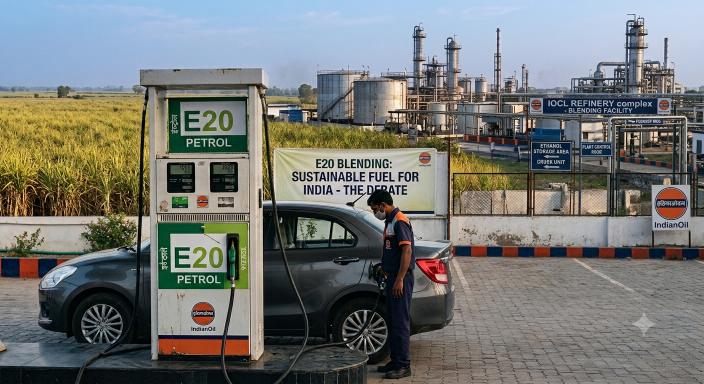
The clarification comes amid widespread discussions surrounding India’s ethanol blending programme and growing public interest in the rollout of E20 fuel.
How the Controversy Began
The controversy emerged after Bhutanese newspaper The Bhutanese reported that the Bhutan government had requested Indian fuel suppliers to continue providing conventional petrol instead of E20. The report cited concerns over the country’s fuel storage infrastructure and the handling requirements associated with ethanol-blended petrol.
The report quickly gained traction on social media and entered India’s political discourse, with opposition leaders referencing it while criticising the Centre’s ethanol blending policy.
Bhutan Newspaper Stands by Its Report
Responding to India’s clarification, The Bhutanese editor Tenzing Lamsang maintained that the publication’s report was based on official written and verbal communications from Bhutanese government authorities.
He also acknowledged India’s long-standing support in ensuring uninterrupted fuel supplies to Bhutan, describing the petroleum ministry as a reliable partner.
Bhutan’s Concerns Focus on Infrastructure
To support its report, The Bhutanese released what it described as a written response from Bhutan’s Department of Trade.
According to the document, Bhutan is currently not importing E20 petrol due to concerns over ethanol’s hygroscopic nature, which allows it to absorb moisture. Officials reportedly cautioned that this could affect fuel quality and vehicle performance if storage systems are not adequately equipped.
The document further highlighted that several underground fuel storage tanks used by dealers may not be suitable for handling ethanol-blended fuel without upgrades.
Request Was for Continued Supply of Regular Petrol
The Bhutanese document states that during technical meetings, Bhutan requested Indian public sector oil companies to continue supplying regular motor spirit (petrol) for as long as it remains available in India.
It also requested advance notice before India transitions to fuels containing higher ethanol content, allowing sufficient time to modernise storage infrastructure and fuel handling facilities.
Notably, the document does not indicate that India formally offered to export E20 petrol to Bhutan, which aligns with the Indian government’s clarification.
Debate Over E20 Continues in India
The clarification arrives amid an ongoing debate over the nationwide introduction of E20 petrol. Some motorists have expressed concerns regarding fuel efficiency and vehicle maintenance after using ethanol-blended fuel.
However, both the Central government and automobile manufacturers have consistently rejected claims linking E20 to widespread engine damage or significant performance issues.
Government Defends Ethanol Blending Programme
India’s Ministry of Information and Broadcasting has reiterated that E20 was introduced only after extensive laboratory evaluations, vehicle testing and field trials.
The government maintains that ethanol blending adheres to internationally accepted standards and does not automatically invalidate vehicle warranties. Officials also say there is no credible evidence connecting E20 with large-scale engine failures.
Auto Industry Reassures Consumers
During a recent media interaction, automobile manufacturers reaffirmed that E20-compatible vehicles have undergone rigorous testing before being introduced to the market.
Union Petroleum Minister Hardeep Singh Puri also accused certain vested interests of spreading misinformation regarding ethanol-blended fuel. He assured that any future increase in ethanol content beyond 20 percent would be implemented only after comprehensive scientific testing and consultations with industry stakeholders.
Nitin Gadkari Backs Ethanol Push
Union Road Transport and Highways Minister Nitin Gadkari has remained one of the strongest advocates of ethanol blending. He has repeatedly argued that opposition to ethanol is being driven by vested lobbies and has emphasised that ethanol production benefits sugarcane farmers while reducing India’s dependence on imported crude oil.
India achieved its target of 20 percent ethanol blending in petrol ahead of schedule in 2025, making the programme a central component of the country’s energy security and agricultural support strategy.
Protesters Seek Consumer Choice
Meanwhile, consumer activists, motorists and civil society groups staged a protest at Delhi’s Jantar Mantar on Sunday against the nationwide rollout of E20 petrol.
The protesters demanded an independent technical assessment of the ethanol blending programme and urged the government to continue offering regular petrol alongside E20, allowing consumers the freedom to choose the fuel best suited to their vehicles.
