


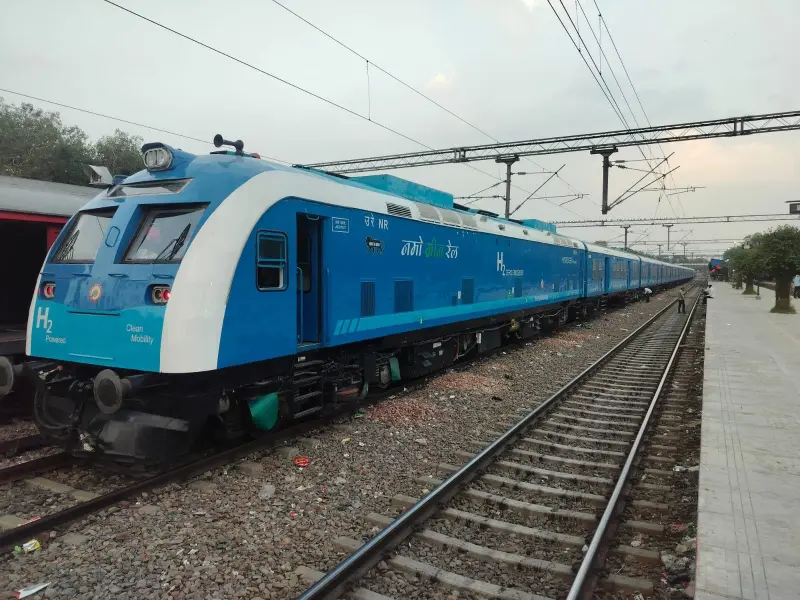
India has reached a major milestone in green rail transport as its first hydrogen-powered train successfully completed a final high-speed trial run from Jind in Haryana on June 26, 2026.
Successful 120 kmph Trial Run
The train was tested on the Jind–Sonipat section at a top speed of 120 kmph. The final trial marks a key step in Indian Railways’ push to introduce hydrogen-powered passenger trains and cut carbon emissions.
Officials monitored the train’s performance closely throughout the test run, with visuals showing the train departing from Jind during the high-speed trial phase.
Jind–Sonipat Route Chosen for Testing
The Jind–Sonipat stretch under Northern Railway was selected as a pilot route due to its suitability for real-world testing conditions.
Indian Railways has also set up hydrogen production, storage, and refuelling infrastructure at Jind to support the project and ensure safe operations.
Focus on Safety and Technology
The hydrogen train comes equipped with multiple safety systems, including hydrogen leak detectors, flame detection units, and continuous monitoring tools.
These systems are designed to quickly detect and respond to any operational risks, ensuring passenger and system safety.
Clean Energy Push
Hydrogen fuel-cell technology powers the train by producing electricity through a chemical reaction between hydrogen and oxygen, releasing only water vapour as a by-product.
This makes it a cleaner alternative to diesel engines, helping reduce both air pollution and noise levels.
Step Toward Green Rail Future
With the successful completion of the high-speed trial, India is closer to launching hydrogen-powered passenger train services.
The development also places the country among a select group globally working on hydrogen rail technology, strengthening its move toward cleaner and more sustainable transport systems.
