


The Indian Air Force on Sunday marked the 25th anniversary of the first flight of the homegrown Tejas Light Combat Aircraft (LCA).
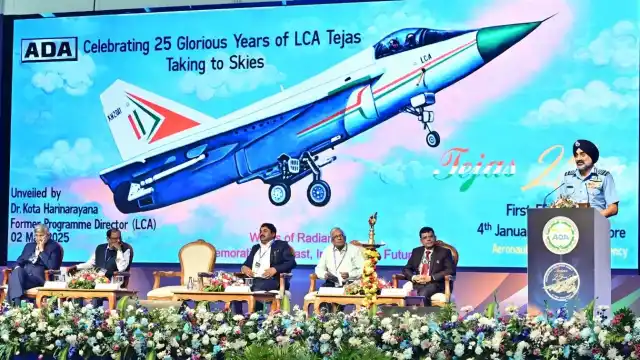
“On the 25th anniversary of Tejas LCA’s historic first flight, the IAF celebrates the enduring partnership behind this fighter. Congratulations to ADA’s scientists, HAL’s engineers, IAF and IN test pilots, and all personnel who have championed self-reliance,” the IAF said in a social media post.
Tejas first took to the skies on January 4, 2001, when Wing Commander Rajiv Kothiyal piloted the Technology Demonstrator (TD-1) from HAL Airport in Bengaluru. This milestone marked the beginning of flight testing, eventually leading to the aircraft’s induction into the Indian Air Force and the development of advanced variants like the Tejas Mk1A.
The Light Combat Aircraft programme was launched in 1983 to develop a new fighter to replace the IAF’s ageing fleet.
Hindustan Aeronautics Limited (HAL) recently received an order for 97 additional Tejas Mk1A jets worth over Rs 62,370 crore, adding to previous orders for 83 aircraft. In May 2025, VEM Technologies in Hyderabad delivered the first centre fuselage assembly for the Mk1A to HAL, marking the first time a major Tejas sub-assembly was manufactured by a private Indian company. The handover was attended by Defence Production Secretary Sanjeev Kumar and HAL Chairman and Managing Director Dr D. K. Sunil.
Earlier in March 2025, the Aeronautical Development Agency (ADA) successfully test-fired the indigenous ASTRA Beyond Visual Range Air-to-Air Missile (BVRAAM) from a Tejas Mk1 prototype off the coast of Chandipur, Odisha. The missile, developed by DRDO, struck its target directly and met all mission objectives. ASTRA has a range of over 100 km and features advanced guidance and navigation systems, and is already inducted into the Indian Air Force.
In the same month, DRDO’s Defence Bio-Engineering & Electro Medical Laboratory (DEBEL) in Bengaluru successfully tested the LCA Tejas’ indigenous On-Board Oxygen Generating System (OBOGS)-based Integrated Life Support System (ILSS). Designed to provide breathable oxygen for pilots without relying on liquid oxygen cylinders, the system underwent high-altitude trials up to 50,000 feet and high-G manoeuvres, meeting stringent aeromedical standards.
