


As India looks to acquire up to 80 military transport aircraft, US aerospace giant Lockheed Martin has pitched its C-130J Super Hercules as the top option, highlighting that an expanded fleet would strengthen India’s tactical airlift capabilities among the Quad nations.
If selected, Lockheed Martin plans to establish a major production hub in India for the C-130J, marking the first global facility outside the US, company officials told PTI.
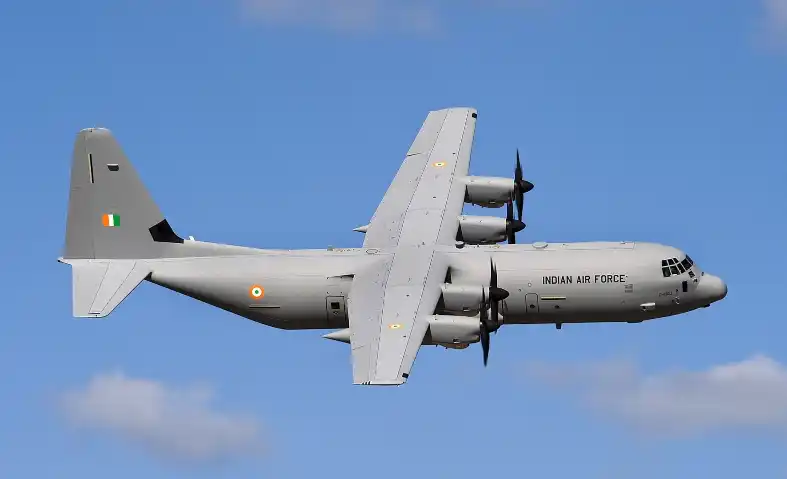
To date, over 560 C-130J aircraft have been delivered worldwide, accumulating more than three million flight hours and serving 28 operators across 23 countries. The Indian Air Force (IAF) currently operates 12 C-130Js.
Beyond the standard transport model, Lockheed Martin offers multiple specialized configurations for intelligence, electronic warfare, special forces support, search and rescue, and command operations. Other Quad members—Australia, Japan, and the US—also operate the C-130J.
“The C-130J Super Hercules delivers superior performance across all operational theatres and is the ideal choice for India,” said Patricia Trish Pagan, Lockheed Martin’s VP for Air Mobility and Maritime Missions.
In 2022, the IAF issued a Request for Information to replace its ageing fleet of AN-32 and IL-76 aircraft. The programme to procure around 80 medium transport aircraft (MTA) is expected to be approved by the Defence Acquisition Council shortly. Competitors include Brazil’s Embraer KC-390 Millennium and Airbus Defence’s A-400M. Lockheed Martin is partnering with Tata Advanced Systems to bid for the C-130J.
Lockheed Martin is incorporating new innovations into the aircraft, including the Distributed Aperture System (DAS), a spherical sensor suite used on F-35 jets, providing enhanced situational awareness, missile warning, and night vision.
Roderick McLean, VP of Sustainment Operations at Lockheed Martin Aeronautics, said the MTA programme could strengthen India-US defence collaboration and industrial capabilities. He emphasized that the C-130J’s unmatched versatility comes from over 70 years of development, with new AI and connectivity systems allowing integration from seabed to space.
“The C-130J’s value lies not only in current capabilities but also in continuous innovation, giving the IAF the chance to leverage our global expertise,” McLean added. He described the programme as the largest international opportunity in the aircraft’s 70-year history.
Robert Toth, VP of business development at Lockheed Martin Aeronautics, called the C-130J a “symbol of hope” with a proven track record in IAF operations. He highlighted that India’s procurement would not be experimental—the platform is durable, well-understood, and fully supported.
Lockheed Martin’s plan to set up a production hub in India is notable, as only the first two prototypes of over 2,700 C-130s were ever built outside Marietta, at Burbank, California. The Indian facility could also serve as a base for exports to other markets.
Toth noted that acquiring additional C-130Js would give India a strategic edge within the Quad, as all other member nations operate the aircraft and are updating their fleets. The US fleet continues to grow, and India’s expanded capability would strengthen its airlift position.
Lockheed Martin emphasized its ability to deliver planes faster than competitors, citing a production capacity of 20–24 aircraft per year in Marietta, with prior peaks of up to 36 annually. The new Indian facility would add surge capacity to meet demand.
Tata Lockheed Martin Aerostructures Limited (TLMAL) in Hyderabad has been manufacturing C-130J empennages and other components for several years, shipping them to the US for final assembly. Recently, TLMAL marked the delivery of its 250th C-130J tail.
The new defence MRO facility in India will integrate into Lockheed Martin’s global network of certified service centres, supporting C-130J Super Hercules, KC-130J, and legacy C-130 B-H aircraft.
