


The year 2025 marked a visible shift in India’s infrastructure landscape, with long-awaited projects finally opening to the public and reshaping the way people travel, trade, and move within cities. Unlike a year defined by a single sector, 2025 saw progress across airports, highways, tunnels, and metro systems, reflecting a coordinated push to enhance connectivity nationwide. While some projects opened fully, others reached partial completion, setting the stage for phased rollouts in early 2026.
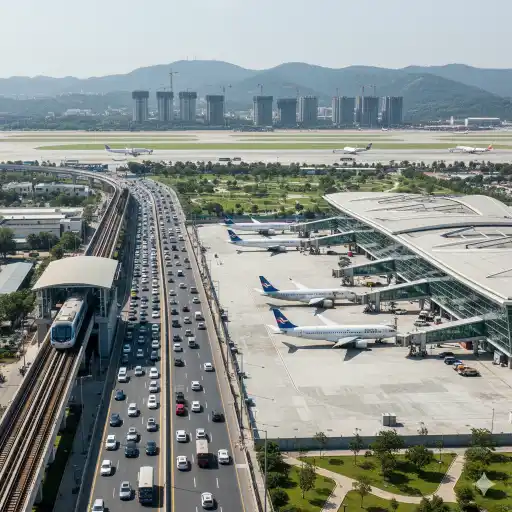
Navi Mumbai International Airport
The operational launch of Navi Mumbai International Airport (NMIA) was a milestone for Indian aviation. Built as a greenfield project at an estimated cost of ₹18,000–20,000 crore, NMIA was designed to relieve Mumbai’s saturated airport and support future growth. With modern terminals, long runways, and phased expansion plans, the airport initially caters to 20 million passengers annually. NMIA immediately eases congestion, cutting travel times by 30–60 minutes for nearby regions and improving reliability for early-morning and late-night flights. Beyond passengers, NMIA strengthens cargo operations, logistics efficiency, and regional economic growth, laying the groundwork for commercial hubs around Navi Mumbai.
Samruddhi Mahamarg (Mumbai–Nagpur Expressway)
Fully operational in 2025, the 701-kilometre Samruddhi Mahamarg, India’s largest expressway project, reduces the Mumbai–Nagpur journey from 16 to around 8 hours. Built at a cost of ₹55,000 crore, the expressway features tunnels, bridges, and high-speed lanes, benefiting both passenger travel and freight movement. It also serves as a vital economic corridor, linking agricultural, industrial, and urban regions, supporting logistics to ports, and driving regional development across Maharashtra.
Sonamarg Tunnel (Z-Morh Tunnel)
Opened in 2025 after ₹2,700 crore investment, the Sonamarg Tunnel bypasses avalanche-prone stretches of the Srinagar–Sonamarg route. It reduces travel time by 20–30 minutes and ensures all-weather connectivity, enhancing safety and reliability for residents and tourists. Strategically, it strengthens access to Ladakh, supporting civilian and military movement in a sensitive border region.
Dwarka Expressway
The ₹9,000-crore Dwarka Expressway became operational in 2025, easing congestion between Delhi and Gurugram. Time savings of 30–45 minutes for daily commuters and improved access to airport zones highlight its immediate benefits. Over time, the expressway is expected to influence urban growth, reduce pollution, and support planned development along its corridor.
Mumbai Metro Line 3 (Aqua Line)
Mumbai’s ambitious underground Metro Line 3, built at ₹33,000 crore, opened in 2025, offering commuters a faster, climate-controlled alternative through the city’s core. The line reduces travel times from over an hour to 20–30 minutes, eases pressure on suburban railways and roads, and encourages a shift to public transport, improving efficiency and quality of life for thousands daily.
Urban Extension Road-II (UER-II)
UER-II in Delhi, costing around ₹6,000–7,000 crore, was inaugurated in 2025 as a high-capacity peripheral road connecting major highways while bypassing inner-city congestion. Time savings of 20–40 minutes, smoother logistics, and reduced fuel usage highlight its immediate advantages. In the long term, it supports urban expansion and balanced traffic distribution in the National Capital Region.
Projects Near Completion for 2026
Several projects completed structurally in 2025 are set to open in early 2026. The Ganga Expressway in Uttar Pradesh will boost east–west connectivity, while segments of the Delhi–Dehradun Expressway will reduce travel time to Uttarakhand. The Mumbai–Vadodara–Delhi Expressway, a ₹1 lakh crore corridor, is partially open, cutting the Delhi–Mumbai journey nearly in half once fully operational.
Through these milestones, 2025 demonstrated that India’s infrastructure pipeline is now delivering phased, tangible benefits, transforming connectivity, trade, and urban mobility across the nation.
