


The winners of the NASA Space Apps Challenge were honored at the IEDC Summit 2025, organized by Kerala Startup Mission (KSUM) and jointly hosted by L.B.S. College of Engineering, Kasaragod, and the Central University of Kerala, Kasaragod.
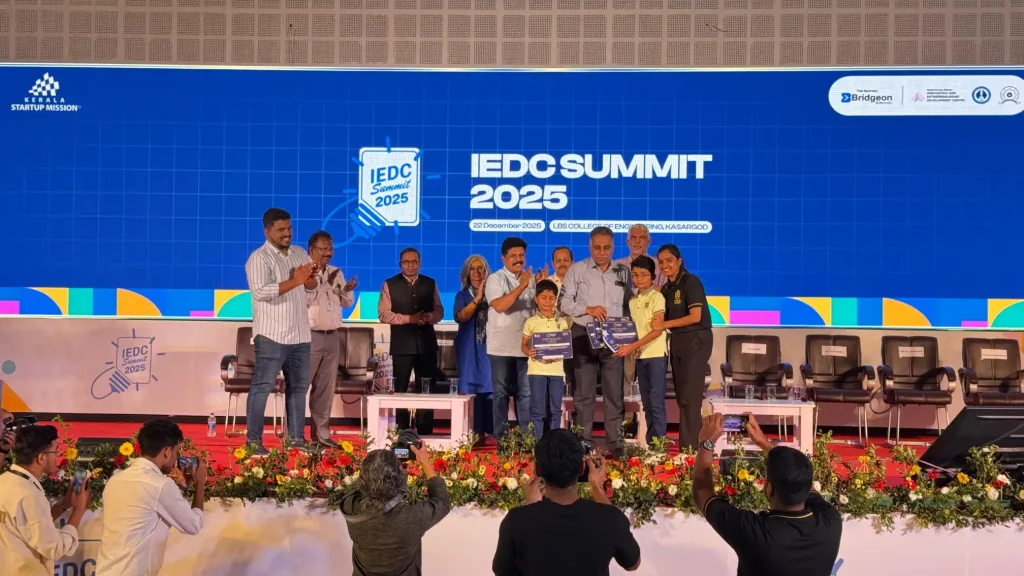
Kerala Teams Shine on the Global Stage
Two Kerala-based teams emerged as global finalists in this year’s challenge. Meteor Rizzlers, consisting of Riyan Raz, Zakiel Chungath, Sanjay Varghese, Shwethin Nikesh Kumar, and Roshith Robert, and Celesta, made up of Janeetta Cardoz, Athira S, Aparna Antony, Melvin George Mathew, Abisha Mariam Biju, and M Sumith Muralidharan, competed among 16,860 teams worldwide to reach the top 45.
Unique World Robotics Leads Organization
Kerala education technology startup Unique World Robotics (UWR) served as the largest global organizer for the NASA Space Apps Challenge 2025. A registered startup under KSUM, UWR conducted 22 regional events across India, the UAE, and Europe, with eight events held in Kerala alone.
Massive Participation and Impact
From UWR-organized centers, 15,308 participants formed 2,276 teams, submitting over 1,200 projects. This accounted for 13.42% of global registrations and 13.5% of teams, highlighting the scale of UWR’s contribution. “This is a remarkable achievement,” said company founder Banson Thomas George.
Diverse Fields of Innovation
The challenge encompassed a wide range of disciplines including storytelling, software development, astrophysics, agriculture, and space exploration. Meteor Rizzlers represented Rajagiri School of Engineering and Technology in Kochi, while Celesta comprised students from St Joseph’s College of Engineering and Technology, Palai, who participated from Kanjirappally in Kottayam district.
Turning Curiosity Into Opportunity
Founded with the mission of transforming curiosity into opportunity, UWR brought the NASA Space Apps Challenge to Kerala to connect local talent with the global space sector. “More than 10,000 people participate in this program every year. This achievement will fuel the goal of enabling the next generation to engage confidently with the global space ecosystem,” George added.
