


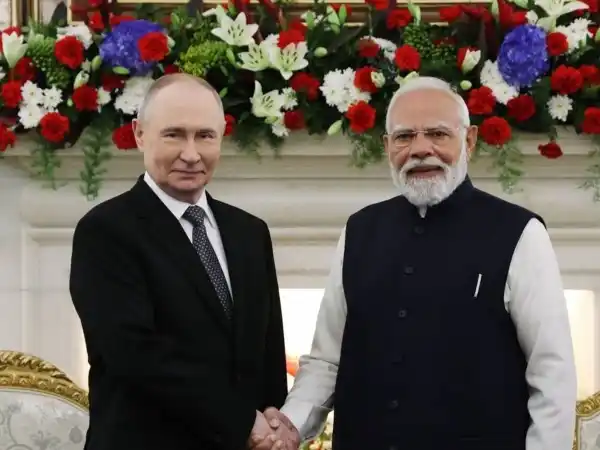
Prime Minister Narendra Modi and Russian President Vladimir Putin met in New Delhi on December 5, reaffirming a partnership both leaders described as steady through decades of global turbulence. The summit produced a wide set of agreements, a renewed economic roadmap, and fresh areas of cooperation stretching from the Arctic to civil nuclear energy.
Stepping up Arctic coordination
One of the quieter but significant lines in the joint statement was the decision to hold regular consultations on Arctic-related issues. Both sides noted the steady progress they’ve already made on the Northern Sea Route, a corridor that could reshape future trade as polar ice continues to melt. India’s interest in the Arctic runs deep. It goes back more than a century through the Svalbard Treaty of 1920, which gave signatory countries, including pre-independence India under British rule, the right to carry out non-military commercial and scientific activities in the region. India’s own footprint grew sharply after 2007. That year, it launched its first Arctic expedition and later set up Himadri, its research base in Svalbard. Indian teams have since examined glaciers, ocean systems, atmospheric change, pollution and microbiology. Over 25 institutions now contribute to India’s Arctic work, with more than a hundred peer-reviewed papers published since the first mission. India also built a multi-sensor moored observatory in Kongsfjorden and a high-latitude atmospheric lab in Ny-Ålesund, marking major steps in polar science. With climate change accelerating Arctic transformation, New Delhi and Moscow see the region not only as a site for research but also a strategic space for future sea routes and mineral access.
Civil nuclear plans move forward
Energy security sat at the centre of the talks. Modi highlighted nuclear power as a key pillar, and Russia agreed to expand cooperation across the full life cycle of the Kudankulam nuclear project. Two 1,000-MW units are already running, while four more of the same capacity are under construction. The goal is to complete the full 6,000-MW complex by 2027. Both leaders also opened the door to a second nuclear plant. India said it would work to identify and allot a new site under earlier agreements, while technical and commercial discussions on Russian VVER reactors will speed up.
Building ties in space and science
The partnership in space also received attention. ISRO and Roscosmos will deepen work on navigation systems, planetary missions, rocket engine development and human spaceflight. Both countries described this as an enhanced partnership built on the peaceful use of outer space.
A push toward a $100-billion trade relationship
The summit brought more than a dozen new agreements across health, migration, maritime trade and technology. Modi and Putin adopted a framework aimed at boosting bilateral trade to $100 billion by 2030. Russia stressed it would continue uninterrupted shipments of fuel to India and called New Delhi’s foreign policy independent and self-driven. India emphasised the need for balanced trade and more avenues for Indian exports. Both sides backed rapid talks on a Free Trade Agreement between India and the Eurasian Economic Union. New Delhi announced a 30-day e-tourist visa and a 30-day group tourist visa for Russian travellers. A manpower mobility pact is also expected to create new work opportunities on both sides.
Defence and strategic stability
Defence cooperation remains steady, but the summit focused more on economic ties than new military deals. India raised the issue of Indians serving in the Russian army and sought their early release. Putin underlined that both nations shape global discussions through BRICS and the SCO, working with countries that favour a multipolar world order. He said the partnership reflects adherence to international law and respect for sovereignty. Both leaders supported reforming the UN Security Council to reflect current global realities, with Russia again backing India’s bid for a permanent seat.
Regional and global issues
They also agreed to keep Afghanistan free of terrorism and backed dialogue-driven solutions on the Iran nuclear question. The joint statement noted concern over the humanitarian crisis in Gaza.
A partnership built on stability
Modi summed up the tone of the meeting by saying the India-Russia relationship has stayed steady like a guiding star. The summit’s range—from Arctic research to trade, nuclear energy, workforce mobility and space—shows both sides see their ties entering a broader and more practical phase.
