


Late November 2025 marked a watershed moment for India’s private space sector as Narendra Modi unveiled Vikram-I, the country’s first privately developed orbital-class launch vehicle, from Hyderabad-based startup Skyroot Aerospace. Vikram-I stands 20 metres tall and 1.7 metres wide, built using lightweight all-carbon composite materials, enabling high efficiency and structural strength.
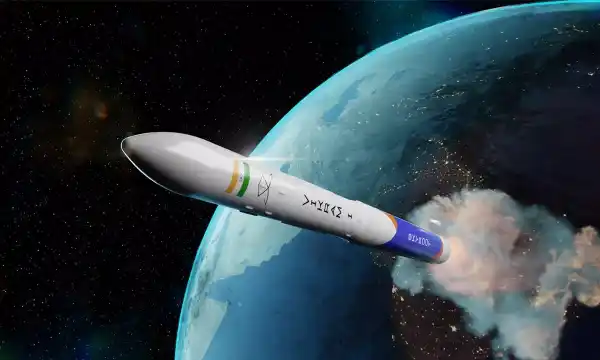
The four-stage rocket combines robust solid-fuel propulsion in its first three stages with a hypergolic liquid-fuelled upper stage, ensuring both powerful lift-off and precise orbital insertion. Its design includes state-of-the-art innovations, 3D-printed engine components that reduce weight by roughly 50% and accelerate manufacturing, ultra-low-shock pneumatic separation systems, and advanced avionics for real-time guidance.
Vikram-I is built for versatility: it is designed to deliver up to ~ 350 kg into Low Earth Orbit (LEO) or ~ 260 kg into a Sun-Synchronous Orbit (SSO), depending on mission parameters, making it ideal for small satellites and enabling both dedicated and rideshare launches.
Importantly for the budding commercial space market, Vikram-I can be assembled and made launch-ready within 24 hours from any suitably equipped launch site, a big step toward “on-demand” access to space.
With Skyroot’s newly inaugurated “Infinity Campus”, a 200,000 sq ft facility capable of producing one orbital launch vehicle per month, Vikram-I is positioned as the vanguard of a new era: private, agile and scalable satellite launches from India.
