


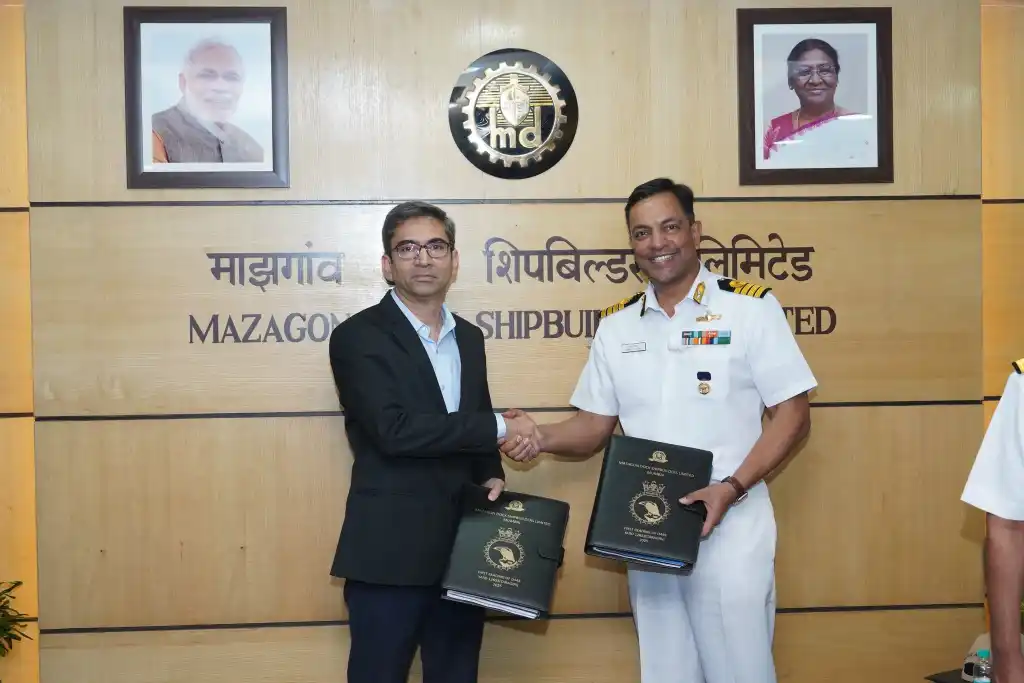
Taragiri, the third stealth frigate built under the Navy’s Project 17A, has officially joined the fleet. The ship, designed and produced in India and packed with advanced combat systems, was handed over on November 28 at Mazagon Dock in Mumbai.
This vessel is the fourth in the Nilgiri-class lineup and the third constructed by MDL. According to the Navy, Taragiri represents a major step forward in homegrown naval design, stealth features, automation, and overall combat strength.
Project 17A ships are built for multi-mission roles and are intended to handle a wide range of present and future challenges at sea. Taragiri carries a powerful mix of weapons and sensors, including the BrahMos missile system, MFSTAR radar, the MRSAM air-defense complex, close-in weapon systems in 30 mm and 12.7 mm calibers, and anti-submarine rockets and torpedoes.
It’s the fourth Project 17A frigate delivered in just 11 months. Lessons learned from the first two ships helped shorten Taragiri’s construction time to 81 months, compared to 93 months for the class lead ship, Nilgiri.
Three more P17A frigates are still in the pipeline—one at MDL and two at GRSE—with deliveries planned through August 2026.
The name Taragiri has history. The original INS Taragiri, a Leander-class frigate, served from 1980 to 2013 and completed 33 years of operations.
Designed by the Warship Design Bureau and monitored by the Warship Overseeing Team in Mumbai, the P17A class marks a significant jump in India’s ability to design and build complex warships. The program uses an integrated construction approach to keep timelines on track.
Compared to the earlier Shivalik-class (P17), these ships carry a more advanced weapons and sensors package. They run on a CODOG propulsion setup—a combination of diesel engines and gas turbines—driving controllable-pitch propellers, all managed through a modern integrated platform management system.
Taragiri’s delivery underscores India’s growing shipbuilding capability and the Navy’s continued push for indigenous design and production. With about 75 percent local content and participation from over 200 MSMEs, the project has provided direct employment to around 4,000 people and indirect work to more than 10,000.
