


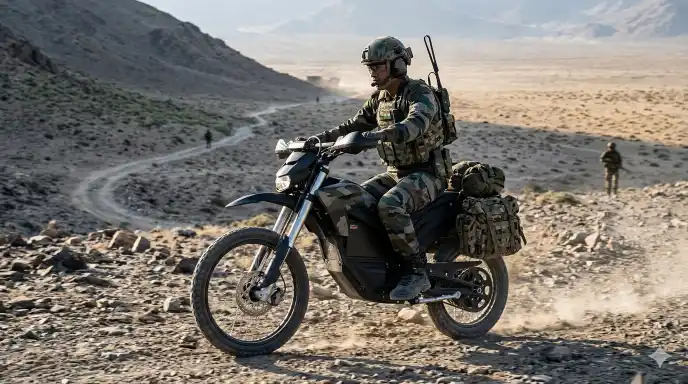
In March 2026, the Indian Army took a major step toward electric mobility by issuing and closing tenders for a new class of “Silent Scout” electric motorcycles and scooters. These vehicles are designed not just as replacements for traditional petrol-powered bikes but as tools that redefine mobility, reconnaissance, and communication in forward operating areas.
Key Procurements and Tenders
Central to this initiative is tender GEM/2026/B/7383148, issued by the Department of Military Affairs, focusing on electric motorcycles and scooters for operational use. A related sub-tender, GEM/2026/B/7293693, targets “Battery Operated Two Wheeler Messengers,” highlighting the Army’s need for silent, rapid communication between forward command posts while maintaining radio silence.
Operational Environments and Tactical Advantage
The bikes are intended for diverse terrains, from the dense hills of Assam to the open deserts of Rajasthan. Silent mobility provides a tactical edge in surveillance and troop movement, allowing units to operate close to adversaries without detection. Near-zero acoustic signatures are required, making the bikes virtually inaudible at a distance of 10 meters.
Durability, Load, and Thermal Management
Army specifications emphasize durability, with a minimum five-year lifecycle support. The bikes must carry fully equipped soldiers weighing up to 120 kilograms along with tactical gear and communication equipment. Electric propulsion reduces thermal visibility, unlike petrol engines that retain heat and are easily detected by drones or thermal imaging.
Indian Manufacturers Adapting Electric Platforms
Several domestic manufacturers are adapting their electric vehicles for military use. Royal Enfield’s Flying Flea brand offers the S6 scrambler for off-road patrols. TVS is promoting its eFX concept with belt-drive systems and digital reconnaissance integration. Hero MotoCorp’s Vida platform is being configured for stability and performance in rugged and high-altitude terrain.
Multi-Role Capability with Vehicle-to-Load Integration
A notable feature of these bikes is Vehicle-to-Load capability, allowing onboard batteries to power night vision devices, communication systems, and electronic warfare equipment. This reduces the need for extra battery packs and extends operational endurance for small units in remote or hostile locations.
Doctrinal Shift in Battlefield Philosophy
The move from conventional motorcycles like the Royal Enfield Bullet to electric platforms reflects a broader shift in Army philosophy. Modern reconnaissance and forward mobility now prioritize stealth, energy efficiency, and multi-role capability over raw engine power, with conventional high-noise motorcycles increasingly viewed as operational liabilities.
