


The government has increased the supply of small 5-kg LPG cylinders nationwide, allowing consumers to buy them easily at authorised distributors by showing a valid ID. This step comes amid rising demand and supply pressures due to ongoing West Asia tensions affecting energy logistics.
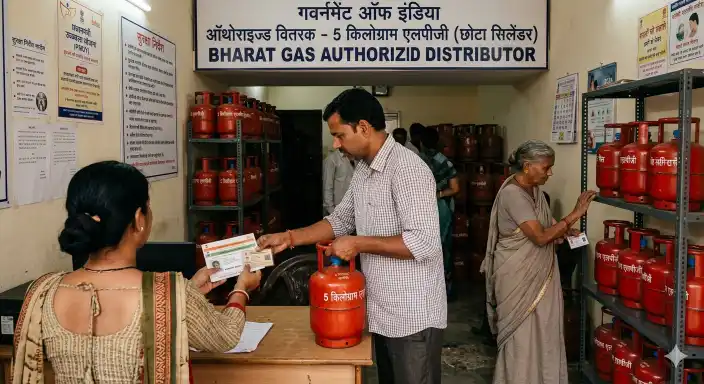
No Address Proof Needed
The Ministry of Petroleum and Natural Gas has clarified that 5-kg free trade LPG (FTL) cylinders can be purchased without submitting any proof of address. Consumers only need a valid government-issued ID such as:
- Aadhaar Card
- PAN Card
- Driving Licence
- Voter ID
- Any State or Central Government-issued ID
No extra paperwork or address verification is required, simplifying access for migrant workers and others without permanent addresses.
Growing Supply to Meet Demand
The Centre has ramped up production and distribution, selling approximately 6.6 lakh cylinders since March 23, with over 90,000 sold on April 4 alone. Authorities report that over 51 lakh domestic LPG cylinders were delivered in a single day, and online bookings now account for nearly 95% of total demand.
Special Support for Vulnerable Groups
To help migrant workers and other at-risk consumers, 11 dedicated help desks have been set up at select HPCL outlets. These provide guidance on nearby distributors and ensure smooth access to 5-kg cylinders.
Crackdown on Illegal Practices
The government has intensified anti-hoarding measures in the LPG supply chain. Since March, over 50,000 cylinders have been seized, more than 1,400 show-cause notices issued, and 36 dealerships suspended for violations.
Priority Supply for Households and Essential Services
LPG and PNG supply has been prioritised for households and essential sectors, including hospitals and schools. Commercial LPG supply has been limited to 70% of pre-crisis levels to secure domestic availability.
Natural Gas Supply
Household and transport sectors continue to receive full natural gas supply. Fertiliser plants are expected to receive around 90% of average consumption from April 6, supported by incoming LNG shipments.
