


Sanskrit, one of the world’s oldest and most influential languages, holds a special place in India’s cultural and historical heritage. Recognised as one of the 22 scheduled languages under the Indian Constitution, it has official status nationally. However, only a few states have formally adopted Sanskrit at the state level for administrative purposes. Uttarakhand led the way in 2010 by declaring Sanskrit as its second official language, followed by Himachal Pradesh in 2019. These measures aim to promote the learning, preservation, and cultural relevance of the language.
Education and Revival Efforts
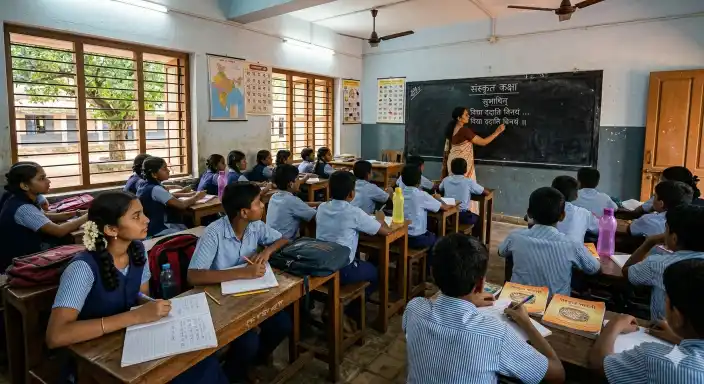
Despite its ancient roots, Sanskrit continues to have relevance today through active revival initiatives. The language is commonly included in school curricula and is offered as a third language for students from Class 5 to 8 under boards like CBSE, and sometimes as a second language for higher classes. Beyond formal education, organisations such as Samskrita Bharati have been instrumental in popularising spoken Sanskrit. As of 2025, the organisation claims to have trained over 10 million people in conversational Sanskrit and prepared more than 135,000 teachers. One notable initiative includes establishing over 6,000 “Sanskrit-speaking homes,” where families use the language in daily communication.
Popularity and Usage
According to the 2011 census, more than 3.1 million people in India identified Sanskrit as a first, second, or third language, though only around 24,821 declared it as their mother tongue. This gap highlights the contrast between its popularity as a subject of learning and its limited use in everyday conversation. Experts suggest that cultural affinity plays a significant role in its continued interest.
Global Interest and Digital Presence
The revival of Sanskrit extends beyond India. Universities in countries such as Germany, the UK, the US, and China offer Sanskrit courses, reflecting global interest. In a major digital milestone, Sanskrit was added to Google Translate in 2022 after consistent demand, showing its growing relevance in the modern digital landscape. The revival movement dates back to the late 19th century, with organisations like the Theosophical Society pioneering early efforts to preserve and promote the language.
Sanskrit Today
Sanskrit remains deeply rooted in India’s cultural and educational systems, supported by institutions and growing global interest. While it may not be widely spoken as a living language, ongoing initiatives in education, cultural programs, and digital platforms ensure that this ancient language continues to thrive in a modern context.
