


India has taken a major step in strengthening its air defence capabilities, with the Defence Research and Development Organisation (DRDO) successfully completing early development trials of its ambitious Project Kusha.
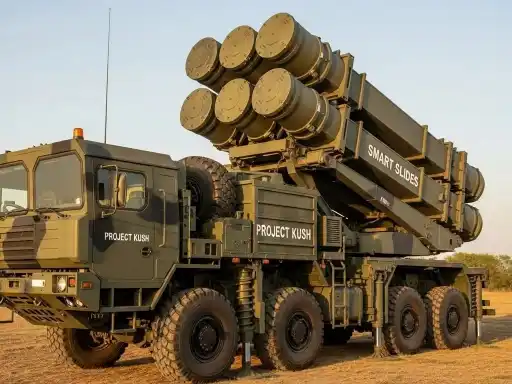
Project Kusha is an indigenous long-range air defence system designed to detect, track, and neutralise a wide range of aerial threats including fighter jets, drones, cruise missiles, and even hypersonic weapons.
The system is being developed as a multi-layered missile shield featuring three interceptor variants—M1, M2, and M3—with ranges extending from around 150 km to nearly 400 km.
Positioned as India’s answer to advanced systems like the S-400, Project Kusha aims to reduce dependence on foreign defence imports while boosting self-reliance under the country’s indigenous defence push.
Once fully developed and inducted, expected between 2028 and 2030, the system will form a critical part of India’s layered air defence architecture, significantly enhancing its ability to counter evolving aerial threats.
