


Researchers at the Graphene India 2026 conference highlighted how MXene-based materials could revolutionize future energy storage technologies, including batteries and supercapacitors.
During sessions focused on two-dimensional (2D) materials for energy applications, experts such as Prof. Rupesh S. Devan (IIT Indore), Dr. Rakhi Raghavan Baby (CSIR-NIIST), and Chandra Sekhar Rout (Jain University) presented developments in MXene research aimed at higher energy density, faster charging, and longer-lasting devices.
MXenes are ideal for electrodes because of their excellent electrical conductivity, large surface area, and mechanical strength. These properties allow electrons and ions to move more efficiently within batteries, increasing storage capacity and reducing charging time. Researchers are exploring MXene-based electrodes for technologies like sodium-ion batteries, lithium-ion capacitors, and next-generation supercapacitors.
Supercapacitors, unlike traditional batteries, store and release energy almost instantly. Adding MXenes enhances their energy density while preserving rapid charging, making them suitable for electric vehicles and grid-level storage. The conference also highlighted hydrogen storage using 2D materials, which could accelerate the adoption of hydrogen as a clean energy carrier.
Experts emphasized that improving energy storage technology is key to advancing electric mobility. Faster-charging, high-capacity batteries could reduce range anxiety and make long-distance travel more practical. At the same time, cost-effective, scalable production methods for 2D materials remain crucial for commercial deployment.
New Nanomaterials Push the Boundaries of Electronics
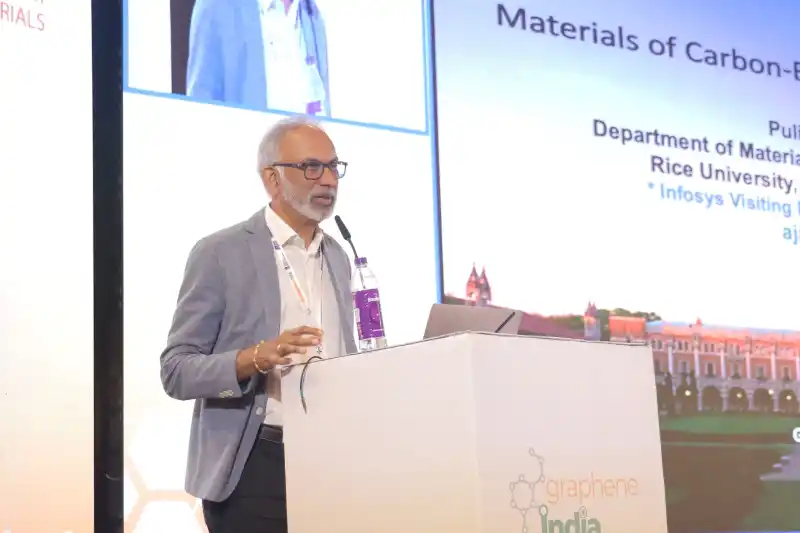
The conference also spotlighted materials combining carbon, boron, and nitrogen, with Prof. Pulickel M. Ajayan of Rice University, USA, explaining their potential in nanotechnology and materials science.
Prof. Ajayan discussed carbon-boron-nitrogen compositions such as carbon (C), boron nitride (BN), carbon nitride (CN), and boron–carbon–nitrogen (BCN) compounds. These materials can be synthesized in both hexagonal and cubic forms, opening doors to advanced 2D and 3D structures.
Such materials promise applications in electronics, energy storage, and multifunctional nanocomposites where durability, heat resistance, and electrical performance are essential. Their development could shape the next generation of high-performance devices.
