


Prime Minister Narendra Modi left for Israel on 25 February for a two-day state visit, marking his first trip to Israel as Prime Minister since 2017, before Israel’s PM Benjamin Netanyahu visited India the following year. This visit comes after the ceasefire agreement between Israel and Hamas under the “Comprehensive Plan to End the Gaza Conflict” last October, and following India’s condemnation, along with over 100 other nations, of Israel’s settlement expansion in the West Bank.
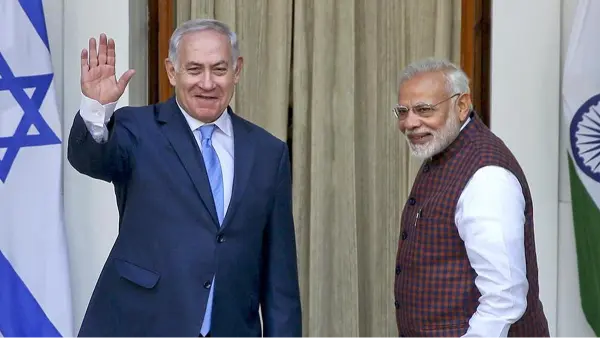
On departure, PM Modi said he would hold talks with PM Netanyahu to explore ways to strengthen cooperation across multiple sectors. He will also meet Isaac Herzog, the President of Israel. The Ministry of External Affairs highlighted the visit amid heightened US-Iran tensions, as the Pentagon has mobilized forces in the region ahead of upcoming talks in Geneva on Iran’s nuclear program.
The visit aims to review and deepen the India-Israel Strategic Partnership, with discussions spanning science, technology and innovation, defence and security cooperation, agriculture and water management, trade and economic ties, and people-to-people exchanges. The leaders are also expected to exchange perspectives on regional and global matters of mutual interest. “This visit will reaffirm the long-standing strategic partnership and help realign efforts toward a robust collaboration between two resilient democracies,” the MEA statement noted.
On Day 1, 25 February 2025, PM Modi will arrive at Ben Gurion International Airport in Tel Aviv, hold a tête-à-tête with PM Netanyahu, address the Knesset, visit an exhibition of technologies and innovations, and attend a private dinner hosted by PM Netanyahu. On Day 2, 26 February 2025, he will visit the Holocaust memorial Yad Vashem, hold bilateral meetings with President Isaac Herzog, participate in delegation-level talks with PM Netanyahu, sign MoUs, issue joint press statements, and interact with the Indian-Jewish community. PM Modi will be received at the airport by PM Netanyahu and his wife, Sara.
Reports indicate the visit will advance cooperation in air defence, including India’s integration into Israel’s laser-based air defence system (Or Eitan), with defence remaining a cornerstone of bilateral ties. Both nations will also sign MoUs focused on disruptive technologies such as AI, quantum computing, and cybersecurity. Key takeaways from the visit include a focus on cooperation in emerging technologies, continued strengthening of defence ties, and engagement on regional and global issues, along with enhancing people-to-people exchanges.
