


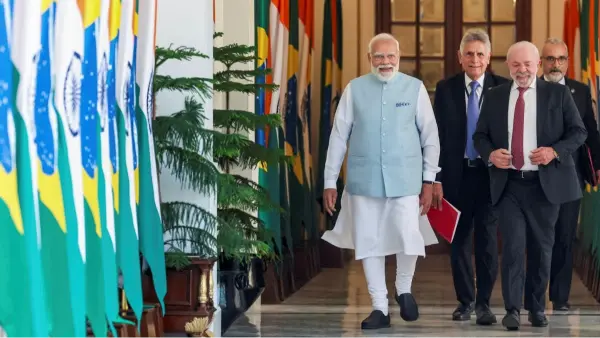
India and Brazil signed a memorandum of understanding (MoU) on rare earths and critical minerals during President Lula da Silva’s state visit to India on 21 February 2026. The joint statement highlighted the two countries’ intention to cooperate across the full mineral value chain, including exploration, mining, processing, recycling, and refining, with the aim of strengthening supply chains and enhancing competitiveness.
India is working to build domestic capacity across the critical minerals value chain and reduce dependence on any single country by forging more overseas partnerships. Domestically, the Union Cabinet approved the National Critical Mineral Mission in January 2025, covering exploration, mining, beneficiation, processing, and recovery from end-of-life products. The mission is planned to run from 2024-25 to 2030-31 with significant public investment.
India also published a list of 30 critical minerals in July 2023 and used the Mines and Minerals (Development and Regulation) Amendment Act 2023 to give the Centre greater power to auction blocks for critical and strategic minerals. By September 2025, multiple auctions had been conducted across several blocks. The state-backed entity Khanij Bidesh India Ltd. is exploring overseas acquisitions and signing exploration agreements, including in Argentina and Chile. The government has also adjusted customs duties to reduce the cost of importing scarce inputs, including critical minerals and recyclable scrap. India is also promoting domestic late-stage manufacturing, with Union Minister for Mines G. Kishan Reddy stating that India aims to start producing rare-earth permanent magnets domestically by the end of 2026, reducing import dependence for sectors such as electric vehicles and defence.
According to Secretary (East) P. Kumaran, President Lula emphasized Brazil’s “substantial” but largely unexplored mineral reserves, noting that Brazil values India as a partner for exploration and processing. The MoU is non-binding but strengthens India’s bargaining position by providing an additional source for critical minerals, allowing India to negotiate better terms with other suppliers. The agreement also reassures companies that their inputs will be less vulnerable to export restrictions or geopolitical shocks, encouraging investment. Harmonizing environmental and sourcing standards between India and Brazil could further facilitate the sale of finished products to global markets that demand traceability.
India joined the U.S.-led Pax Silica initiative on 20 February, aimed at securing supply chains for the “silicon stack” — from raw materials to computing infrastructure including AI hardware. While the bilateral MoU with Brazil could contribute to accessing and processing minerals relevant to this goal, Brazil is not a member of Pax Silica, and the MoU’s activities are independent of the initiative.
Brazil has vast mineral reserves, including 21 million tonnes of rare-earth-oxide equivalent, 2.7 billion tonnes of bauxite, 270 million tonnes of manganese, and 0.4 million tonnes of lithium, according to the U.S. Geological Survey. The MoU provides Brazil an opportunity to attract Indian capital and buyers, facilitating financing for new mines and processing plants. It also supports Brazil’s goal to move up the value chain by covering exploration, mining, processing, recycling, and refining, while strengthening its negotiating position and ensuring long-term market stability.
