


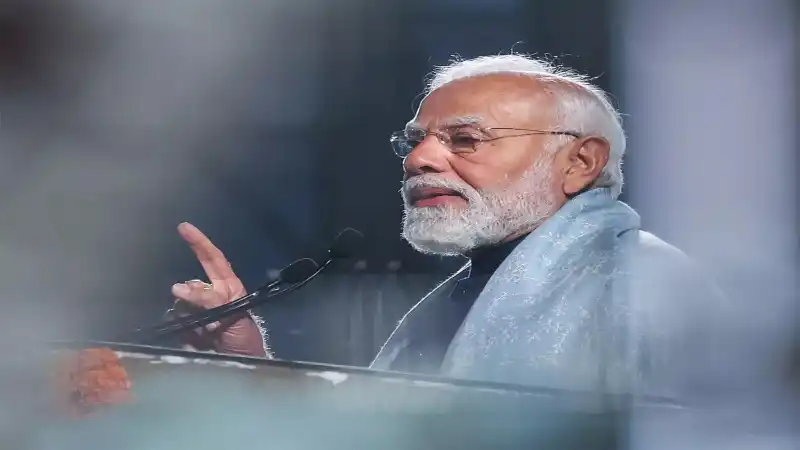
Prime Minister Narendra Modi and Union Minister for Electronics and Information Technology Ashwini Vaishnaw outlined India’s vision for artificial intelligence at the India AI Impact Summit 2026 in New Delhi, highlighting the country’s efforts to promote responsible AI development, strengthen global cooperation, and address concerns related to misuse, employment, and public trust. The summit brought together global leaders, technology companies, startups, and researchers to discuss the future of AI with a focus on inclusion, accountability, and real-world impact. As the first major AI gathering of its kind hosted in the Global South, the event reflects India’s ambition to shape international AI standards while building domestic capabilities.
Under the IndiaAI Mission, the government has committed ₹10,372 crore to develop a strong national AI ecosystem. The initiative includes onboarding over 38,000 GPUs for shared computing infrastructure, developing 12 indigenous foundation models, and approving more than 30 AI applications tailored to India’s needs. Talent development remains a central focus, with thousands of students at undergraduate, postgraduate, and doctoral levels receiving support through specialised programmes.
The summit witnessed participation from more than 45 countries, including global leaders such as Emmanuel Macron, Luiz Inácio Lula da Silva, and António Guterres. A strong delegation from the United States and senior executives from companies such as Microsoft, IBM, Zoom, Kyndryl, and Adobe also attended, signalling expanding global collaboration in AI innovation.
Key discussions focused on reducing the AI adoption gap between developed and developing countries, building secure and sovereign digital systems, strengthening ethical governance frameworks, and ensuring that AI enhances livelihoods rather than displacing workers. The AI Impact Expo, spanning more than 70,000 square metres, showcased AI-driven solutions across sectors including agriculture, healthcare, education, and public services. Through thematic sessions and working groups, the summit aims to generate practical recommendations such as shared computing frameworks and AI resources for public use, positioning India as a bridge between technological innovation and equitable global progress.
Modi described the summit as a powerful convergence of ideas, innovation, and intent, noting that it demonstrated the potential of Indian talent in shaping artificial intelligence for global benefit. He emphasised that rational thinking and intelligence are essential to ensuring that technology serves society and reaffirmed India’s commitment to deploying AI responsibly, inclusively, and at scale for human development.
Vaishnaw, meanwhile, said India is engaging with ministers from more than 30 countries to develop technical and legal measures to tackle the misuse of AI in media. He stated that the government is working on strict regulations that would require watermarking and clear labelling of AI-generated content to protect the authenticity of human creativity.
The minister warned that misinformation, disinformation, and deepfake technologies pose serious risks to public trust, weakening institutions such as families, social structures, and governance systems. He stressed that social media platforms, AI developers, and content creators share responsibility in ensuring that emerging technologies strengthen trust rather than undermine it. According to him, freedom of expression itself depends on trust, making issues such as deepfakes and data breaches critical concerns for society.
His remarks follow recent government directives instructing digital platforms to establish mechanisms to identify and label AI-generated content to prevent illegal, misleading, or exploitative material. He also announced the upcoming Create in India mission, aimed at strengthening industries, generating employment opportunities, and developing a future-ready workforce.
Addressing concerns about AI’s impact on jobs, Vaishnaw said the technology should complement human work rather than replace it, highlighting India’s expanding talent pipeline and skill development initiatives. The government has also proposed setting up content creator labs in 15,000 schools and expanding AI education alongside existing semiconductor training programmes.
He further noted that artificial intelligence is not a threat to human creativity or storytelling but an opportunity for growth. With strong copyright and intellectual property protections, he said, AI and human innovation can evolve together and drive progress across both industrial and creative sectors.
