


India began electrifying its railways in 1925 with a 1,500 Volt DC system running between Bombay Victoria Terminus and Kurla Harbour. While this first electric train covered only a short distance, it laid the foundation for more efficient rail transport in the country. Progress remained slow over the following decades, with steam and diesel locomotives dominating. By independence, only 388 route kilometers (RKMs) were electrified.
Acceleration in Recent Years
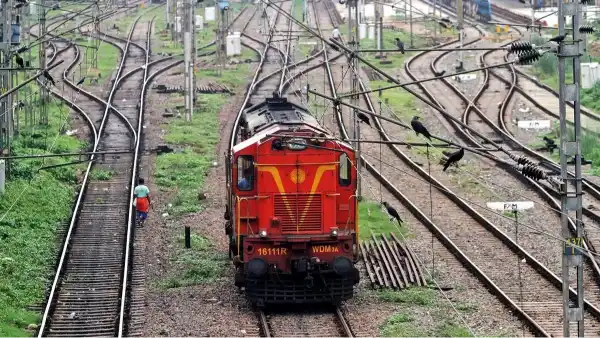
Significant strides were made in the last two decades, as Indian Railways focused on cleaner, more sustainable operations. Electrification advanced from roughly 1.42 km per day during 2004–2014 to about 15 km per day between 2019–2025, marking a major acceleration. The share of electrified routes rose from 24% in 2000 to 40% in 2017, and surged to 96% by the end of 2024. As of November 2025, India has electrified 69,427 RKMs, covering approximately 99.2% of its rail network, with 46,900 RKMs added in 2014–2025 alone.
Global Leaders in Rail Electrification
Switzerland – Fully Electrified (100%)
Switzerland sets a global benchmark with a fully electrified rail network powered entirely by renewable hydroelectric energy. Complete electrification allows for frequent passenger services and smooth connectivity across challenging terrains.
India – Near Complete Electrification (99.2%)
From its first short suburban line in 1925 to nearly 70,000 RKMs electrified today, India now has one of the largest and fastest-growing electrified rail networks in the world. Its rapid progress over the past decade is unmatched globally.
China, Spain, Japan, France – Highly Electrified (60–90%)
China operates the world’s largest high-speed rail network, with 82% electrification; some freight and remote lines still use diesel. Spain (67%) and Japan (64%) rely mostly on electrified high-speed corridors, while regional or lightly used lines remain diesel-operated. France (60%) combines electrified mainlines with diesel regional services.
Russia – Moderately Electrified (40–60%)
Russia’s extensive geography and harsh climate have limited full electrification. While main trunk routes, like the Trans-Siberian Railway, are electrified, much of the network still uses diesel locomotives.
United Kingdom – Limited Electrification (Below 40%)
Despite being one of the world’s oldest railway systems, only 39% of the UK’s rail network is electrified. High costs and legacy infrastructure have slowed expansion, leaving diesel trains in widespread use.
