


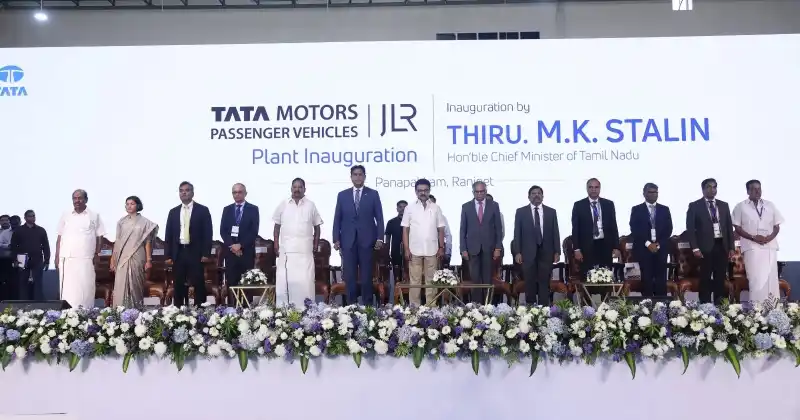
Tata Motors has officially begun operations at its new Panapakkam plant in Tamil Nadu, marking more than just the launch of a manufacturing facility. The Range Rover Evoque is the first vehicle to roll out locally, signaling a shift in the joint strategy of Tata Motors and Jaguar Land Rover, one that positions India at the heart of future manufacturing, cost efficiency, and multi-powertrain scalability.
Local assembly of the Evoque highlights India’s growing role in JLR’s global production network. While the model was previously assembled in India as a CKD unit, the Panapakkam plant is a next-generation facility designed to produce premium vehicles alongside Tata-branded models. This setup allows JLR to reduce reliance on global supply chains, improve cost competitiveness in emerging markets, and establish regional production hubs closer to demand. For India’s luxury vehicle market, which remains relatively niche, local manufacturing also enables more flexible pricing without affecting brand positioning.
The plant is capable of handling multiple powertrains—internal combustion engines, electric vehicles, and future technologies—on modern modular platforms. By sharing manufacturing infrastructure, Tata Motors and JLR can cut costs, lower investment risk, and speed up time-to-market for new products. This flexibility could allow additional JLR models, especially compact luxury SUVs and EVs, to be assembled in India for both domestic sales and exports.
Although the Evoque is the first model to be produced, the plant has been built with electrification in mind. This aligns with Tata Motors’ push toward EV leadership and JLR’s global shift to electrified luxury vehicles. A renewable-energy-powered, flexible facility in India allows selective localisation of future electric models and enables Tata Motors to scale up EV and hybrid production under its own brand efficiently.
Beyond vehicle assembly, the Panapakkam plant represents a long-term investment in employment, skills, and the supplier ecosystem. It is expected to create over 5,000 direct and indirect jobs at peak capacity and will focus on skill development through Tata’s Lakshya programme. Leveraging India’s skilled workforce, JLR can nurture future-ready talent while gradually localising components, supporting cost efficiency and supply resilience.
Strategically, the Panapakkam facility underscores a deeper alignment between Tata Motors and JLR. India is no longer just a sales market or CKD base—it has become a core manufacturing hub. As global automotive markets face slower growth, rising costs, and stricter regulations, this integration gives both companies operational flexibility. In the coming years, the plant is set to play a central role in manufacturing, electrification, exports, and cost competitiveness from an Indian base.
