


The Indian Railways is finalizing plans to implement seven new bullet train corridors announced in the Union Budget 2026. Officials said Detailed Project Reports (DPRs) for these high-speed rail (HSR) corridors will be updated with current cost estimates to ensure accurate financial viability assessments, following a high-level Railway Board meeting.
NHSRCL Directed to Ensure Timely Progress
The National High Speed Rail Corporation Limited (NHSRCL), responsible for the ongoing Mumbai–Ahmedabad bullet train corridor, has been instructed to take immediate action to keep projects on schedule.
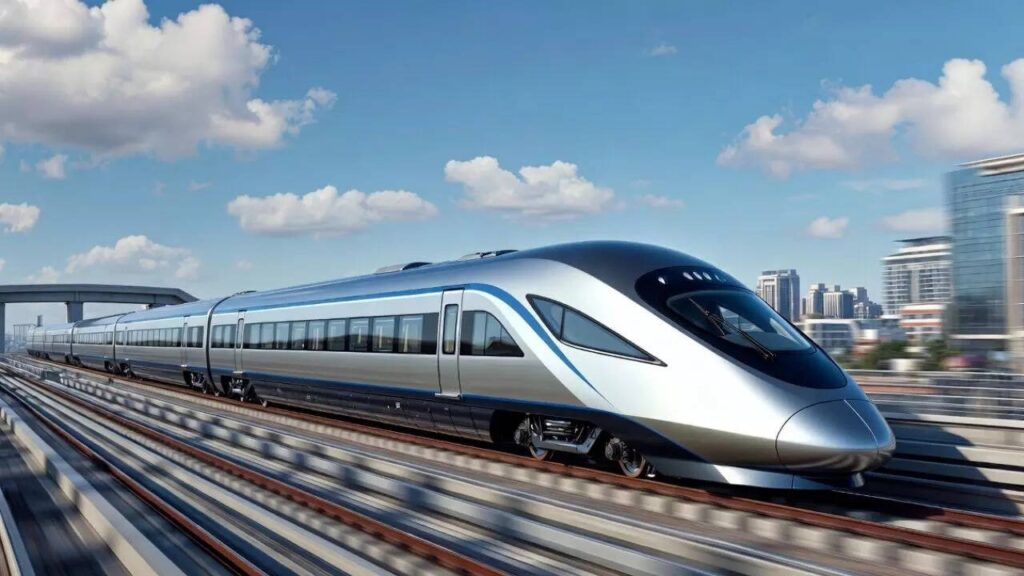
Proposed High-Speed Rail Corridors
The new corridors proposed in the 2026–27 budget include Mumbai–Pune, Pune–Hyderabad, Hyderabad–Bengaluru, Hyderabad–Chennai, Chennai–Bengaluru, Delhi–Varanasi, and Varanasi–Siliguri. Collectively, these corridors will cover nearly 4,000 km and are expected to attract investments of around Rs 16 lakh crore.
Standardisation and Pre-Construction Initiatives
Officials have emphasized standardizing high-speed rail systems across India, forming dedicated field-based teams for each project, and initiating pre-construction activities, including contract documentation. Planning for trained technical manpower to support large-scale HSR implementation is also underway to ensure readiness. Progress on all action points will be closely monitored to accelerate development.
Mumbai–Ahmedabad Corridor Updates
India plans to operate its first bullet train along a 100 km stretch by 2027. The Mumbai–Ahmedabad High-Speed Rail Corridor (MAHSR) will span about 508 km, covering 352 km in Gujarat and Dadra & Nagar Haveli and 156 km in Maharashtra, connecting cities including Sabarmati, Ahmedabad, Anand, Vadodara, Bharuch, Surat, Bilimora, Vapi, Boisar, Virar, Thane, and Mumbai.
Rising Costs Due to Land Acquisition Delays
Delays in land acquisition have nearly doubled the project cost from earlier estimates of Rs 1.08 lakh crore, highlighting challenges in implementing large-scale high-speed rail projects in India.
