


India is increasingly looking to the Gulf region as a strategic trade partner amid global trade tensions and tariff barriers. The Gulf Cooperation Council (GCC), a union of six West Asian countries, is now India’s largest trading bloc, surpassing the European Union, ASEAN, and even top bilateral partners such as the United States and China.
Bilateral trade between India and the GCC reached around $179 billion in 2024-25, driven largely by CEPA agreements with the UAE and Oman. Major Indian exports include gems, metals, electronics, chemicals, and other industrial goods. India is now negotiating a free trade agreement (FTA) with the six-nation GCC, which includes Saudi Arabia, the UAE, Qatar, Kuwait, Oman, and Bahrain.
India has already signed CEPA agreements with the UAE in May 2022 and Oman in December 2025. The new FTA is expected to eliminate duties and non-tariff barriers across the remaining GCC countries, boosting exports and trade flows. The Gulf region also provides India with vital energy security and hosts around 10 million Indian residents.
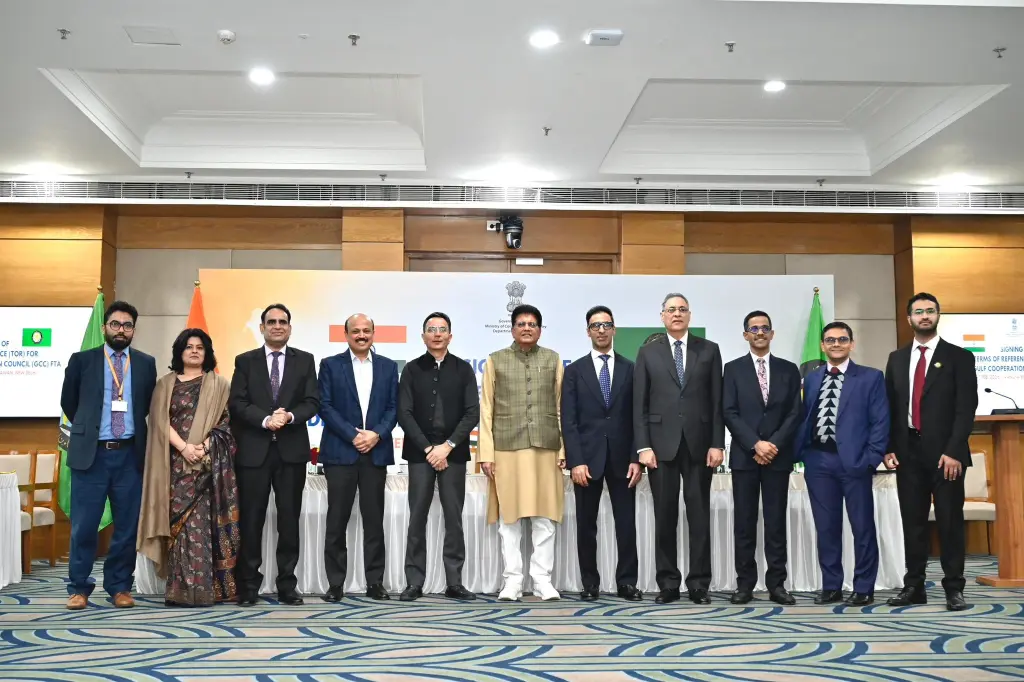
On February 5, 2026, India and the GCC signed the terms of reference (ToR) to formally launch FTA negotiations. Commerce and Industry Minister Piyush Goyal said the pact would enhance bilateral trade and investments, improve policy predictability, and encourage the free flow of goods and services. He emphasized that the agreement would also strengthen food and energy security for both India and the GCC nations.
India imports primarily crude oil and natural gas from the Gulf, while exporting products ranging from pearls and precious stones to chemicals, metals, and machinery. In 2024-25, India’s exports to the GCC were around $57 billion, up slightly from $56.3 billion the previous year, while imports rose 15.3% to $121.7 billion, bringing total bilateral trade to $178.7 billion. The UAE remains India’s third-largest trading partner, with exports of $36.6 billion and imports of $63.4 billion. Saudi Arabia, Qatar, Oman, Kuwait, and Bahrain are also major trade partners, with India running trade deficits in each case due mainly to energy imports.
Experts, including economist Jeffrey Sachs, highlight the Gulf as a growing market for India, offering opportunities for sectors such as petrochemicals, ICT, and manufactured goods. With the FTA in place, India aims to expand its exports, strengthen economic ties, and diversify energy sources, leveraging the region’s strategic importance for trade and investment.
