


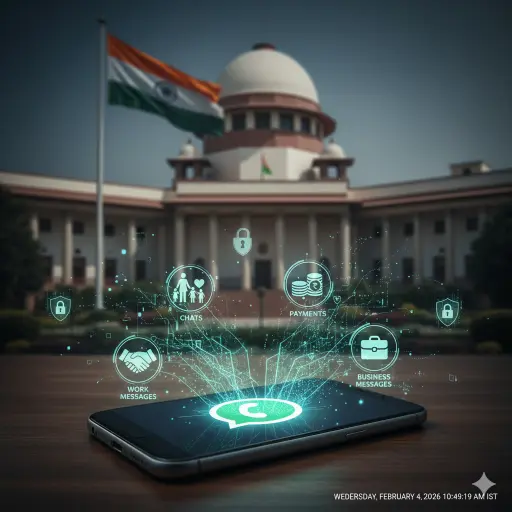
WhatsApp has become an inseparable part of daily life in India, used for everything from family chats and work updates to payments and business communications. That’s why the Supreme Court’s stern warning to Meta, WhatsApp’s parent company, has attracted widespread attention. When Chief Justice Surya Kant said, “If you can’t follow our Constitution, leave India,” it was more than courtroom drama—it was a firm statement on the country’s commitment to protecting user privacy. But what led to such a strong reaction, and does this mean WhatsApp could be forced out of India?
How the Privacy Controversy Began
The current issue traces back to WhatsApp’s 2021 privacy policy update. The update stated that, as part of the Facebook family of companies, WhatsApp could share user information with other Meta-owned firms. This data could be used to operate, improve, and customize services, as well as support marketing efforts. For users, the choice was stark: accept the new terms or delete the account. There was no way to opt out of data sharing while continuing to use the platform. WhatsApp later clarified that personal chats remain end-to-end encrypted. However, data shared with businesses could still be collected and used for advertising on Facebook. Despite these reassurances, concerns persisted, particularly given WhatsApp’s massive presence in India.
Privacy Issues Resurface in 2026
The matter reached the Supreme Court in appeals filed by WhatsApp and Meta against a Competition Commission of India (CCI) order. The CCI had imposed a Rs 213.14 crore penalty, citing the policy’s impact on competition and user choice. During the hearings, the Court took a firm stance. It questioned how consent could be genuine when users faced a “take it or leave it” situation. Justice Joymalya Bagchi described this as “manufactured consent,” suggesting users were coerced into agreeing. Chief Justice Surya Kant added, “Where is the question of opt out? This is a decent way of committing theft of private information.” The Bench also highlighted WhatsApp’s dominance, noting that most consumers have little alternative because “everybody uses it.” The Court emphasized that the right to privacy is non-negotiable: “We will not allow to share a single piece of information. You can’t play with the right to privacy in this country,” stressing that business interests cannot override constitutional protections.
WhatsApp’s Response
India Today Tech reached out to WhatsApp for comment, but the company declined. In court, Meta’s senior counsel, Mukul Rohatgi, argued that WhatsApp is free to use and noted that related issues are pending before a Constitution Bench. Senior counsel Arun Kathpalia stated that not all user data is shared, only specific categories, and that personal messages are not accessed by WhatsApp. Despite these clarifications, the Court appeared skeptical, given the scale of WhatsApp’s operations and its influence in India.
Supreme Court Sets February 9 Deadline
The Supreme Court has ordered WhatsApp and Meta to file an affidavit clearly stating they will not share user data. The case is listed for interim directions on February 9. The Bench warned that failing to provide such an undertaking could lead to dismissal of the companies’ appeals against the National Company Law Appellate Tribunal (NCLAT) order, weakening WhatsApp’s legal position in India.
Will WhatsApp Leave India?
An immediate exit from India is unlikely. The country is WhatsApp’s largest market, and walking away would be a major business decision. The Supreme Court’s remarks are better seen as pressure to ensure compliance with Indian constitutional values, especially regarding the right to privacy. For users, the outcome could set a precedent for data control, determining how much say Indians have over their personal information and whether free digital services can continue demanding significant hidden costs.
