


Cochin International Airport Limited (CIAL) is set to become the first airport in India to operate hydrogen-powered buses for passenger transport. This follows the signing of a Memorandum of Agreement (MoA) with the Kerala Hydrogen Valley Innovation Cluster (K-HVIC) Foundation. The agreement, formalized at Kochi Airport’s 0484 Aero Lounge, was witnessed by Kerala’s electricity minister K. Krishnankutty and industries minister P. Rajeev, marking a practical step toward implementing hydrogen mobility in aviation.
Three Hydrogen Buses to Be Deployed
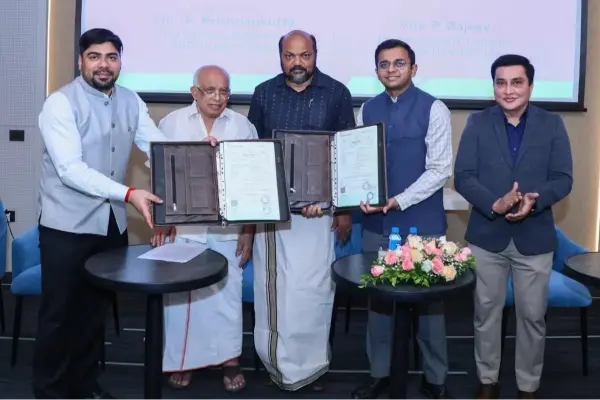
Under the MoA, CIAL will procure and operate three hydrogen fuel cell electric buses as part of the Kerala Hydrogen Valley initiative under India’s National Green Hydrogen Mission. The K-HVIC Foundation will provide financial support for the buses, capped at ₹2.9 crore per vehicle, with a total project cost of ₹8.7 crore. The buses are expected to be delivered within 12 months, with CIAL retaining ownership and responsibility for all operational and regulatory matters.
Green Hydrogen Supply Infrastructure
Fuel for the buses will come from a 1 MW green hydrogen plant being developed jointly by CIAL and Bharat Petroleum Corporation Limited (BPCL). Powered by on-site solar energy, the facility is expected to produce up to 200 kg of green hydrogen daily, sufficient to serve the initial bus fleet and potentially support other local mobility services. All necessary statutory approvals for hydrogen supply have already been secured.
Building on Earlier Trials
The hydrogen bus deployment builds on a pilot program conducted in 2025, where a 9-metre, 30-seat prototype developed by EKA Mobility, KPIT Technologies, and BPCL was tested at the airport. A three-year proof-of-concept program demonstrated the feasibility of fuel-cell buses on intra-airport and short-haul routes, paving the way for the current full-scale deployment.
CIAL’s Decarbonisation Efforts
CIAL, the world’s first fully solar-powered airport with around 50 MW of installed capacity, sees hydrogen as a complement to battery-electric shuttles. Each hydrogen bus is expected to cut roughly 50 tonnes of CO₂ emissions per year, while transporting millions of passengers and creating new employment opportunities in hydrogen operations, manufacturing, and refueling.
Strategic Role of Kerala Hydrogen Valley
The Kerala Hydrogen Valley Innovation Cluster aims to deploy hydrogen across transport, industry, and aviation, including electrolyser manufacturing and synthetic fuel development. By situating a hydrogen hub directly at the airport, the project avoids diesel logistics and associated emissions, offering a strong business case for hydrogen in high-utilisation transport settings.
A Template for India’s Net-Zero Goals
Though modest in scale, CIAL’s hydrogen bus project is being closely watched as a potential model for other airports. It represents a tangible step toward India’s net-zero target for 2070, demonstrating how airports can integrate hydrogen mobility to reduce emissions and improve operational efficiency.
