


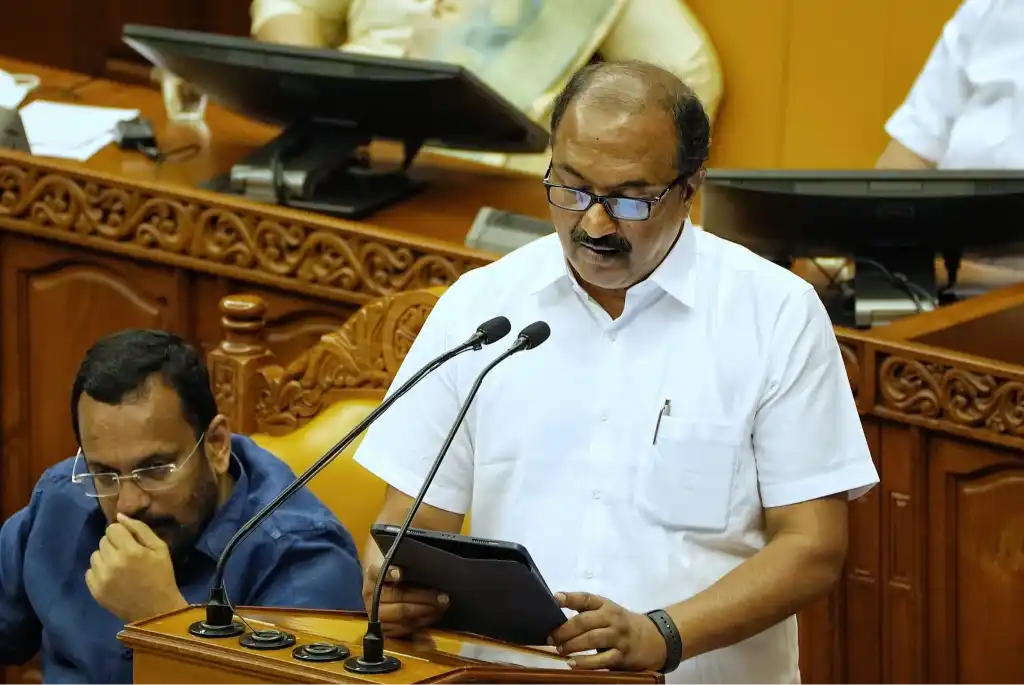
Finance Minister K N Balagopal presented the Kerala State Budget in the Legislative Assembly, projecting a revenue increase of ₹45,889.49 crore. The budget places strong emphasis on infrastructure development, social welfare, education, transport, and employment generation.
One of the major announcements is the proposal for a high-speed Regional Rapid Transit System (RRTS) corridor from Thiruvananthapuram to Kasaragod, to be implemented in four phases on the model of the Delhi–Meerut RRTS. An allocation of ₹100 crore has been made for preliminary works. The project will be executed in four segments: Thiruvananthapuram–Thrissur, Thrissur–Kozhikode, Kozhikode–Kannur, and Kannur–Kasaragod. The Union Ministry of Housing and Urban Affairs has expressed support for the project. Designed largely as an elevated system, the RRTS will be integrated with existing metro rail networks in major cities.
The budget estimates total revenue receipts of ₹1.82 lakh crore and total expenditure of ₹2.4 lakh crore. Effective capital expenditure is projected at ₹30,961.48 crore. The budget targets an increase of ₹10,271.51 crore in own tax revenue and ₹1,595.05 crore in non-tax revenue. The state’s revenue deficit is estimated at ₹34,587 crore, which is 2.12 percent of Gross State Domestic Product (GSDP), while the fiscal deficit stands at ₹55,420 crore, or 3.4 percent of GSDP.
In a historic move, the Finance Minister announced free degree education in Arts and Science colleges. Until now, free education in Kerala was available only up to Class 12. Extending it to the undergraduate level marks a major shift in the state’s education policy and is seen as a landmark decision in the final budget of the second Left Democratic Front government.
The budget speech, which lasted 2 hours and 53 minutes, was the fourth longest in the history of the Kerala Legislative Assembly, after those presented by Thomas Isaac and Oommen Chandy.
Infrastructure and Transport
Alongside the progress of National Highway development, ₹5,217 crore has been allocated through KIIFB for widening the state’s MC Road into a four-lane highway. To ease traffic congestion, new bypasses and junction improvements will be taken up across the state. In the first phase, ₹110.36 crore has been allocated for the Kottarakkara bypass. Construction of bypasses at Kilimanoor, Nilamel, Chadayamangalam, Adoor, Pandalam and Chengannur will also begin soon. A feasibility study for the Kattappana–Theni tunnel road has been allocated ₹10 crore.
A Rare Earth Corridor connecting Vizhinjam Port with Chavara and Kochi will be established, with Chavara as the hub. The project is expected to attract investments worth ₹42,000 crore and generate employment opportunities worth ₹50,000 crore.
Local Governments and Welfare
Local self-government institutions have been allotted ₹3,237 crore as General Purpose Fund, ₹4,316 crore as Maintenance Fund, and ₹10,189 crore as Plan Fund. Welfare pensions have received an allocation of ₹14,500 crore.
A Finance Tower will be set up in Kochi to strengthen financial administration. From April 1, the Assured Pension Scheme will replace the contributory pension system, guaranteeing a maximum pension of 50 percent of basic pay along with Dearness Relief. Employees currently under NPS will be given an option to switch. Pending DA and DR arrears for government employees and pensioners will be fully cleared, with one installment paid along with February salaries and the remaining with March salaries. The 12th Pay Revision Commission has been announced, with its report expected within three months. The House Building Advance (HBA) scheme for government employees has been reinstated.
Education, Health and Social Security
An accident insurance scheme has been announced for students from Classes 1 to 12, with an estimated annual cost of ₹15 crore. The school education sector has been allotted ₹1,128 crore.
Monthly wages of anganwadi workers and helpers, ASHA workers, literacy instructors, and pre-primary teachers have been increased by ₹1,000. Journalist pension has been raised by ₹1,500 per month. Monthly allowances for librarians and pensions for cancer, leprosy, AIDS and tuberculosis patients have also been increased by ₹1,000.
To preserve the legacy of former Chief Minister V S Achuthanandan, ₹20 crore has been allocated for establishing the VS Centre in Thiruvananthapuram. District hospitals will set up menopause clinics with an allocation of ₹3 crore.
Under the Life Saver Scheme, road accident victims will be assured cashless treatment for the first five days. ₹30 crore has been allocated under the KARE scheme to provide medicines for patients suffering from Spinal Muscular Atrophy.
Employment, Industry and Innovation
The agriculture and allied sectors have been allocated ₹2,071.95 crore. The Chief Minister’s Women Safety Scheme has received ₹3,720 crore, while the Connect to Work scholarship scheme has been allocated ₹400 crore. An additional ₹1,000 crore has been earmarked for employment guarantee programmes. A project to issue Nativity Cards to all Kerala citizens has received ₹20 crore.
Funds have also been allocated for a Critical Minerals Mission (₹100 crore), a Defence Corridor (₹50 crore), and a Cyber Valley integrating artificial intelligence and emerging technologies at Infopark Kochi under the PPP model (₹30 crore). ₹10 crore has been set aside for a Global Skill School, ₹150 crore for expanding the Work Near Home initiative, ₹20 crore for Gig Worker Hubs, and ₹60 crore for a Special Enrichment Programme to improve education quality in tribal areas.
Green Mobility and Senior Citizens
Owners scrapping old petrol and diesel autorickshaws to purchase electric autos will receive a one-time scrappage bonus of ₹40,000. Loans for electric autorickshaws will carry a 2 percent interest subsidy. ₹20 crore has been allocated for installing solar-based charging units at auto stands.
The government will provide subsidies worth ₹30 crore for setting up retirement homes by organisations, groups, and individuals. An additional ₹10 crore has been allocated to provide on-call volunteer services for elderly persons living alone.
The Advocate Welfare Fund limit will be increased to ₹20 lakh. ₹50 crore has been allocated for a new health insurance scheme for families outside the eligibility limits of the Karunya Arogya Suraksha Scheme. ₹10 crore has been earmarked to develop the Centre for Development Studies (CDS) into a national centre of excellence.
