


Mukesh Ambani on Tuesday introduced a draft artificial intelligence (AI) manifesto for Reliance Industries, outlining the company’s ambition to become an AI-native deep-tech enterprise. The initiative aims to boost productivity tenfold across Reliance’s workforce of over 600,000 employees and create a 10x impact on India’s economy and society.
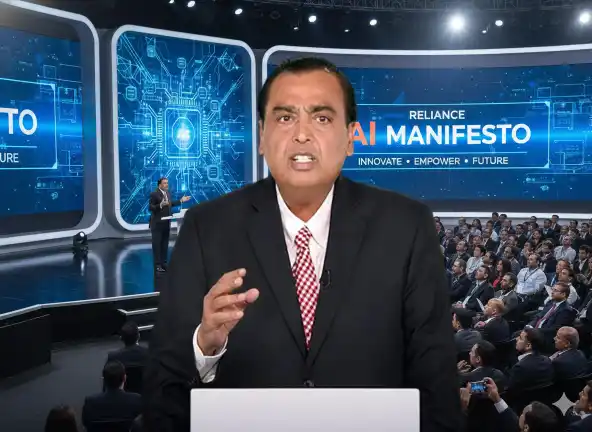
Ambani on Artificial Intelligence
Describing AI as “the most consequential technological development in human history,” Ambani said Reliance plans to lead India’s AI adoption much as it spearheaded the nation’s digital transformation over the past decade. The goal is to deliver “Affordable AI for every Indian,” embedding AI across all Reliance businesses while ensuring safety, trust, and accountability.
“At Reliance, we are transforming into an AI-native company with advanced manufacturing capabilities,” Ambani said in a detailed note to employees. “To guide this journey, we have drafted the Reliance AI Manifesto, which serves as a roadmap for action.”
Key Highlights of the AI Manifesto
The draft manifesto has two parts. The first focuses on internal transformation, presenting AI as a new way of working rather than just a technology program. The second extends the vision to how Reliance’s businesses and philanthropic efforts can accelerate India’s broader AI adoption.
Internally, Reliance plans to reorganize work around outcomes instead of functions. End-to-end workflows—such as procure-to-pay, order-to-cash, hire-to-retire, and plant-to-port—will be re-engineered to remove manual steps, close digital gaps, and enable real-time visibility and decision-making.
“This is not just a technology project. It’s a new way of working,” Ambani emphasized. AI and automation will reduce repetitive tasks, improve decision quality and speed, and maintain human accountability. “It’s not about replacing people, but raising standards and unlocking our organization’s collective potential.”
A 12-layer digital core will standardize data, integration, security, and controls across the group while allowing individual businesses to manage their own platforms. Governance, audit trails, and human-in-the-loop controls will be embedded to ensure that faster execution and greater autonomy do not compromise safety or trust.
Execution will be driven by small, cross-functional “pods” with clear ownership and measurable goals. These teams will move from experimentation to scaling and stable operations, supported by continuous data, learning, governance, and automation cycles.
Extending AI Beyond Reliance
Ambani said the same AI-driven productivity model could benefit India. “Just as we can achieve a 10x improvement in our workflows, we can also deliver a 10x impact on India through our businesses and philanthropic initiatives,” he noted.
Employees are invited to propose ideas for applying AI across Reliance’s portfolio, including telecom, retail, energy, materials, life sciences, financial services, media, and philanthropy. Ambani highlighted platforms like Reliance Jio, with over 500 million subscribers, and India’s largest retail network as opportunities to scale AI access.
The manifesto also emphasizes AI-driven innovation in material discovery, green energy, healthcare, education, and inclusive financial services. Reliance aims to develop indigenous AI hardware, robotics, and energy-efficient systems to support technological self-reliance and sustainability.
Reliance Foundation, the group’s philanthropic arm, will also leverage AI to enhance work in healthcare, education, rural development, disaster management, culture, and conservation.
Employees can submit suggestions for the manifesto between January 10 and January 26, after which it will be finalized.
