


Despite positive GDP growth, India’s micro, small, and medium enterprises (MSMEs) ended 2025 under continued strain. They faced heavy US tariffs, delayed payments, rising regulatory costs, and limited credit access, while government support struggled to reach the ground.
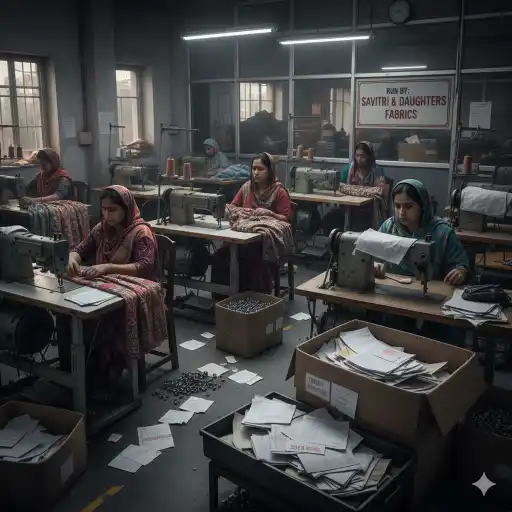
The stress intensified in August when the US, following previous 25% duties, imposed tariffs up to 50% on many Indian exports over New Delhi’s continued purchase of discounted Russian oil. These higher tariffs disrupted orders in labour-intensive sectors such as textiles, leather, and engineering goods, hitting small exporters—who operate on thin margins and limited pricing power—especially hard.
For many MSMEs, the tariff shock triggered a deeper liquidity crisis persisting through the year. India Ratings and Research (Ind-Ra) downgraded the textile sector’s outlook from neutral to negative, noting sharper stress for MSMEs embedded in global supply chains. Large apparel and home textile firms could see revenue drops of 15–25% and margin compression of 2–5% over 12–18 months, while smaller MSME units faced order cuts, delayed payments, and pressure to absorb part of the tariff shock. Some exporters attempted market diversification, but smaller firms lacked capital buffers to adapt quickly.
Payment Delays and Financial Stress
Cash tied up in overdue invoices weighed heavily on India’s 6.4 crore MSMEs, which account for nearly one-third of manufacturing activity and employ millions. Although the delayed payment crisis eased slightly—falling to Rs 7.34 lakh crore in March 2024 from Rs 8.27 lakh crore in 2023—it still represented over 4.6% of national GVA. Delays often occurred with large corporates and public sector buyers.
Closures and Employment Impact
The financial pressure resulted in widespread closures. Since 2020, nearly 1 lakh MSMEs have shut down, mostly micro enterprises exiting without formal insolvency. Job losses frequently went unrecorded, underscoring vulnerability to prolonged cash crunches.
Women-led MSMEs were particularly affected. Between July 2020 and November 2025, 24,545 women-owned MSMEs exited the Udyam registration system, resulting in 1.6 lakh lost jobs. Women-owned businesses represent roughly 15 million of India’s 63 million MSMEs, mostly in low-margin sectors like textiles, food processing, and handicrafts. Barriers such as entrenched gender norms, limited credit access, digital exclusion, and weak policy support continue to restrict women’s participation.
Credit Access and Regulatory Burdens
While overall credit availability increased—MSME credit exposure grew 17.8% year-on-year to Rs 43.3 lakh crore by September 2025—access remained uneven. Banks and non-bank lenders remained cautious, with collateral and documentation requirements limiting smaller firms’ borrowing capacity.
Regulatory compliance added pressure, especially for low-margin manufacturers facing frequent standards changes, high testing costs, and tooling gaps. Digital regulations, such as data protection requirements, also disproportionately burdened small, tech-light firms. Technology adoption remains low: only 7% of MSMEs use AI tools, although over 65% have incorporated digital tools in daily operations, with 31% noting improved efficiency and 27% reporting higher sales.
Green financing awareness remains limited. Nearly three-quarters of MSMEs are unaware of sustainability-linked credit options, despite a majority of applicants securing funding when they apply.
Policy Response and Outlook
The Union Budget provided incremental relief through credit guarantees and simplified procedures, but core issues like payment enforcement, export stress from tariffs, and regulatory costs remained unaddressed. Most measures supporting demand and investment were slow to benefit smaller enterprises.
By year-end, survival dominated the MSME landscape. Firms downsized, deferred hiring, cut discretionary spending, and postponed capacity expansion amid uncertain demand. Exporters focused on retaining existing buyers rather than expanding. Economists caution that the sector’s resilience should not be mistaken for recovery. Without stronger payment discipline, targeted export support, and simplified compliance, MSMEs face entering 2026 with weakened balance sheets and reduced risk appetite.
For India’s MSMEs, 2025 will be remembered as a year defined not by growth or policy announcements but by the quiet endurance of businesses navigating one of their most challenging periods.
